India and Russia Set $100B Trade Target by 2030 with New Partnerships

India and Russia Set $100B Trade Target by 2030 with New Partnerships
Leaders announce wide-ranging deals spanning security, energy, education, and mobility as bilateral trade targets soar toward $100 billion by 2030.
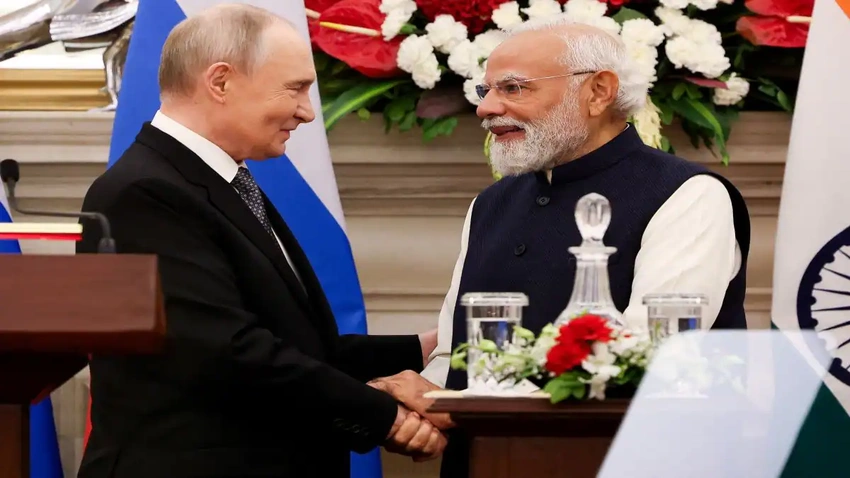
At the summit in New Delhi, the partnership between India and Russia was framed as a multi-faceted push across security, economy, trade and culture. Leaders announced a suite of agreements designed to deepen cooperation, including in education and technology exchanges, and even a move toward manufacturing military parts under the Make-In-India framework. This broad agenda signals an intent to diversify ties beyond traditional defense collaborations and broaden the bilateral agenda to commerce and innovation.
A centerpiece of the discussions is a five-year Economic Cooperation Programme aimed at lifting bilateral trade to $100 billion by 2030, with a practical emphasis on reducing barriers and expanding joint opportunities in logistics, mobility, energy security, and the pharma value chain. Both sides stressed that the plan is not merely aspirational; it includes concrete steps to streamline tariffs and non-tariff barriers and to diversify investment and technology transfer.
Education and science feature prominently as well. A tie-up between the University of Mumbai and Lomonosov Moscow State University was announced, alongside a collaboration between Pune’s Defence Institute of Advanced Technology and Russia’s National Tomsk State University. These links are expected to boost research, higher education, and skilled workforce development, aligning with the broader drive to cultivate talent and innovation in both countries.
On the labor and migration front, a new agreement was outlined to combat irregular migration and to create a structured pathway for workers, balancing Russia’s need for a skilled labor force—particularly in the industrial hubs of the Ural region, which faces a substantial staffing gap—with India's demographic dividend. India, with a large and growing youth cohort, is looking to channel some of its 10–12 million youths entering the workforce each year into opportunities abroad, including in Russia.
The discussions touched on military manufacturing as well, with mentions of Make-In-India initiatives that could see more components produced domestically for defense purposes, reflecting a broader strategy to strengthen supply chains and domestic capabilities even as geopolitical considerations remain central to the bilateral relationship. Overall, the summit framed a future where India and Russia pursue greater economic diversification, greater people-to-people ties, and more integrated grids of cooperation across education, energy, and industry.
Cover image source: How Modi-Putin meet will bring people of the two countries closer 🔗
