Northern Lights Dazzle UK: Rare Aurora Borealis Lights Up South Coast!
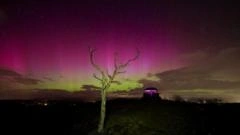
Northern Lights Dazzle UK: Rare Aurora Borealis Lights Up South Coast!
Witness the spectacular Northern Lights! The Aurora Borealis stunned sky-gazers across the UK, reaching as far south as Kent and Devon, thanks to powerful solar activity. See why 2026 is a peak year for this cosmic show!
The skies across the United Kingdom lit up with an extraordinary display of the Northern Lights, or Aurora Borealis, over Friday and Saturday evenings, leaving residents from Scotland to England's south coast utterly mesmerized. This stunning natural phenomenon, usually a rare sight outside the Arctic Circle and northern Scotland, was visible much further south due to exceptionally strong solar activity.
The Met Office confirmed that the breathtaking show, which saw vibrant hues of pink, purple, green, and blue dance across the night sky, was a direct result of powerful solar eruptions known as Coronal Mass Ejections (CMEs) from the Sun.
These charged particles, upon colliding with Earth's atmosphere, create the luminous aurora.
While typically visible only in the northern parts of the UK during moderate activity levels (around 200nT), the recent geomagnetic activity soared to an impressive 600nT. This elevated intensity allowed for widespread sightings, thrilling communities in Wales, Devon, Hampshire, Kent, Norfolk, North Lincolnshire, Denbighshire, Pembrokeshire, North Yorkshire, Orkney Islands, Inverclyde, Anglesey, Surrey, and Wiltshire.
Experts have indicated that 2026 is poised to be a peak year for aurora-spotting, coinciding with the Sun's heightened activity during its natural 11-year cycle. For those who missed out, the Met Office has suggested that further sightings could be possible until Tuesday evening, particularly in Scotland and similar geomagnetic longitudes, provided skies remain clear.
If you're hoping to catch a glimpse, remember a few key tips: look northwards, find a spot away from bright city lights, and use your mobile phone camera. Our eyes' rod cells, which function in low light, don't perceive colour, meaning the aurora often appears in black and white to us.
However, cameras can capture the full spectrum of its glorious colours.
