Adéla Wanted to Become a Pop Star. PRIMA Makes Me Wonder Who Got There First


Adéla Wanted to Become a Pop Star. PRIMA Makes Me Wonder Who Got There First
Adéla Wanted to Become a Pop Star. PRIMA Makes Me Wonder Who Got There First
PRIMA captures a young Slovak star stepping into pop’s biggest stage, but the more polished she becomes, the more you wonder when she’ll stop chasing the pop-star blueprint and create her own.

I have a slight problem with Adéla's PRIMA. I wanted to love it more than I do. This is partly because Adéla herself is such a compelling pop-cultural story. She grew up in Bratislava, trained in ballet and spent years studying the American pop stars she wanted to become. Then came The Debut: Dream Academy, the reality show that eventually produced KATSEYE, where she was eliminated early despite being presented as one of the strongest contestants. That rejection became the beginning of her solo career rather than its ending. Now, at 22, the Slovak singer has an album that has entered the Billboard 200's top five and reached number one on both the US Top Album Sales and Vinyl Albums charts. That is an extraordinary trajectory. It is also what makes PRIMA slightly frustrating.

I Missed the Girl Who Was Willing to Be Weird
The problem is that I keep comparing this album with The Provocateur, the EP that came before it. PRIMA is much more interested in sounding like a pop album that knows exactly where it belongs. The earlier material had the feeling of someone discovering how far she could push her own image. Pitchfork describes that earlier version of Adéla through the deliberately outrageous energy of the EP, while PRIMA moves towards a much more familiar pop vocabulary. You can hear the calculation. There are songs built around sex, glamour and the fantasy of becoming powerful. There are references to the pop canon she grew up studying. There is Y2K dance-pop everywhere. None of this is inherently bad. In fact, some of it is incredibly fun. But I sometimes feel like I am listening to Adéla auditioning for the role of Adéla.

The Album Is Almost Too Good at Explaining Her
The title PRIMA comes from ballet, where prima ballerina represents the highest-ranking female soloist. It is a neat piece of autobiography because Adéla has essentially translated the ambition of the ballet studio into pop. She wants arenas. She wants choreography. She wants the giant cultural machinery that surrounds a genuine pop star.
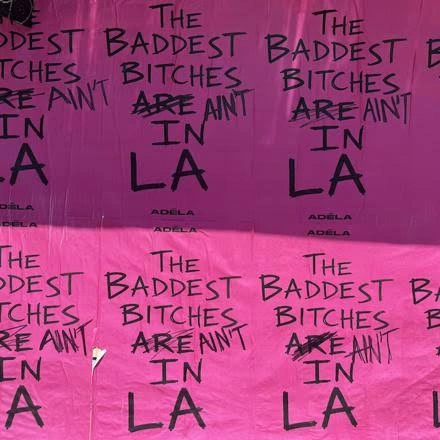
That ambition is most interesting when she allows her Slovak identity into the music. KGB turns her Eastern European background into part of her mythology, while Ain't In LA makes the geographical distance between Bratislava and the centre of the American music industry part of the song's premise. The latter has now become her biggest US hit and made her the first Slovak artist to reach the Billboard Hot 100. This is where I think PRIMA becomes much more important than its music occasionally allows it to be.
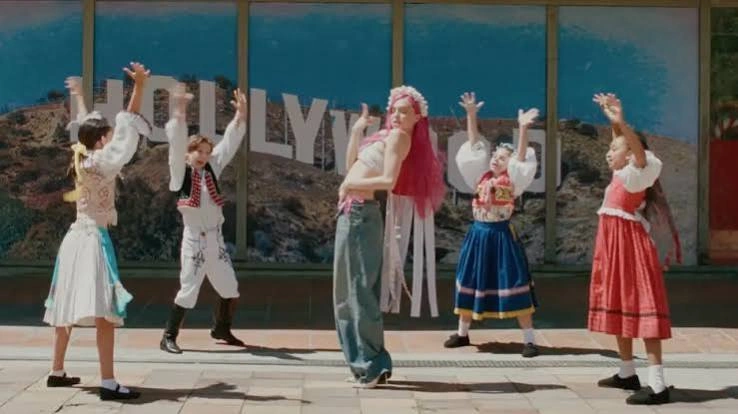
What Happens When the Pop Star Comes From Somewhere Else?
For decades, mainstream pop has treated America as its centre of gravity. An artist from somewhere else can break through, but there is often an invisible translation process involved. You learn the references. You absorb the sounds. You learn the choreography. You become legible to an industry whose idea of global pop has historically been heavily shaped by the English-speaking West.
Adéla has made that process part of her own story. She learned English through American culture and spent her childhood studying the very stars whose world she now wants to enter. Ain't In LA is therefore more than a catchy title. It captures the strange condition of wanting to belong to a cultural centre while constantly reminding everyone that you came from somewhere outside it. And then there is Nicole Kidman, a song born from Adéla seeing herself in a corset and thinking she looked like Kidman. Kidman later acknowledged the song and used Ain't In LA for her TikTok debut. Suddenly the fantasy works in reverse. The American pop-cultural world that Adéla spent years watching has started watching her back.

I Keep Hearing the Label in the Room
This is where my suspicion about PRIMA comes in. I cannot say that Capitol Records forced Adéla to make a safer album. The sources do not establish that, and I do not want to invent an industry conspiracy simply because the record feels more polished than The Provocateur. But Capitol is the label behind the album, and Pitchfork's review makes the corporate quality of the production one of its central criticisms. The record contains contributions from figures including Harrison Smith and Dylan Brady, yet much of it feels assembled from recognisable pop ingredients rather than built around one strange Adéla-specific sound. That is what bothers me.
Adéla has already done the difficult part. She has made it out of a reality-show elimination, crossed an oceanic cultural boundary and become a charting Slovak pop star in America. She does not need to convince me that she understands what pop music sounds like. I want to hear what happens when she stops trying to prove that she understands it.
Adéla Should Take the Risk
The most revealing song on PRIMA might actually be Therapy. It deals directly with the machinery around becoming famous, including the people who control access to her future. Pitchfork reads the song as a particularly exposed moment, because beneath the constructed pop-star persona there is genuine anxiety about whether she can actually make it. That fear suddenly makes the rest of the album more interesting.
Maybe PRIMA sounds cautious because Adéla has spent her entire life trying to get through the door. She has been told she was not quite right for one version of pop stardom, then built another version for herself. Now she has finally arrived inside the industry she spent years studying. And perhaps that is why I find myself slightly disappointed by the album while being more fascinated by Adéla than ever. PRIMA is a record about becoming a pop star made by someone who is still becoming one. Its biggest achievement is not that every song works. It is that a girl from Bratislava can now release an album in America, write songs about the distance between herself and Hollywood, and watch that distance collapse in real time.
I just hope the next album lets her sound less like someone who has finally been admitted into pop music and more like someone who has decided to change the room.
