Edge AI Is Transforming Automotive Intelligence

Edge AI Is Transforming Automotive Intelligence
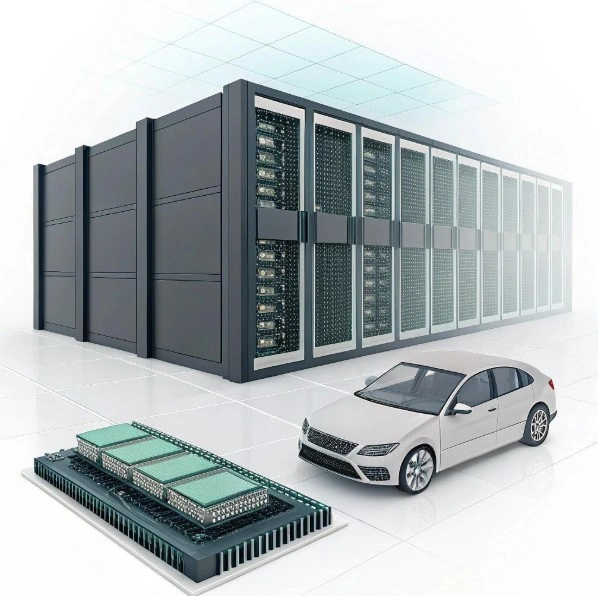
The rapid evolution of connected and autonomous vehicles has sparked a major shift in how cars think. At the core of this transformation lies artificial intelligence on the edge 🔗—a powerful force reshaping how decisions are made in real time. Instead of relying on the cloud, automotive AI processing 🔗now operates directly inside the vehicle, enabling split-second analysis and response. This shift is not just about speed; it’s about redefining vehicle intelligence, safety, and independence.
From smarter driving features to enhanced in-cabin experiences, edge-based AI is taking the driver’s seat in the next generation of mobility.
Autonomous systems rely on massive amounts of sensor data—lidar, radar, cameras, GPS—all of which must be interpreted immediately. Cloud reliance introduces latency and potential failure points. Edge AI ensures that vehicles can react instinctively, even without a stable connection.
By investing in artificial intelligence on the edge, manufacturers are redefining how real-time responsiveness is delivered in automotive AI systems.
Rethinking Intelligence: From Cloud to Edge
Artificial intelligence on the edge marks a departure from traditional cloud-based workflows. In a cloud-first model, data collected by the vehicle is transmitted to remote servers for processing. The problem? Time. When decisions like emergency braking or obstacle avoidance are measured in milliseconds, delay can be catastrophic.
Automotive AI powered by edge computing handles these critical tasks locally. The vehicle doesn’t need to ask permission—it simply acts. Whether avoiding pedestrians, navigating traffic, or responding to road hazards, edge AI enables immediate, autonomous responses.
This local autonomy brings a crucial advantage: consistency. No matter the environment—urban centers, mountain roads, or rural areas with poor connectivity—the vehicle remains alert, responsive, and intelligent.
Smarter Sensor Fusion
Modern vehicles are equipped with dozens of sensors. Cameras detect traffic signs, radar tracks motion, ultrasonic sensors scan for nearby objects, and lidar constructs a 3D model 🔗 of the surroundings. But without a system to fuse this data, you’re left with a fragmented view.
This is where artificial intelligence on the edge excels. Edge processors combine and cross-verify multiple sensor inputs, identifying inconsistencies and creating a unified, real-time picture of the vehicle’s environment.
Sensor fusion backed by edge AI isn’t just about redundancy—it’s about higher confidence. By correlating inputs from different sensors, the system can make more accurate decisions under complex conditions.
Why Edge AI Enhances Safety and Speed
Automotive safety depends on the ability to process data and act quickly. A vehicle swerving into your lane or a child running into the street doesn’t leave time for cloud calls.
Edge-based AI offers ultra-low latency. Data never has to leave the vehicle, which means immediate reaction times. This enables features like:
- Emergency braking
- Adaptive cruise control
- Collision avoidance
- Lane departure correction
Each of these functions relies on real-time processing. Artificial intelligence on the edge ensures these life-saving actions are not only fast but also more reliable.
The Hardware Powering Edge Intelligence
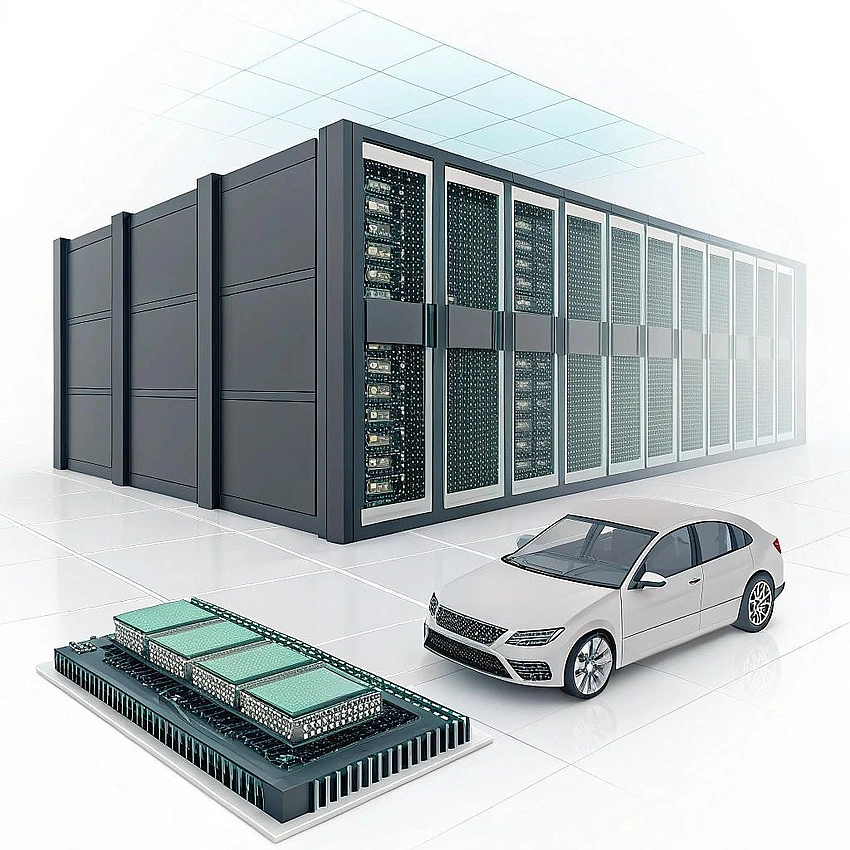
To run AI at the edge, vehicles need specialized chips. Traditional CPUs can’t handle the speed or energy efficiency required. Instead, automotive systems rely on dedicated AI hardware accelerators: NPUs, FPGAs, and ASICs designed for deep learning inference.
These chips are rugged, efficient, and optimized for low-power environments. They can process image recognition, path planning, and driver monitoring while consuming minimal energy—ideal for electric and hybrid vehicles.
SoC (System-on-Chip) designs now bundle multiple accelerators into a single unit, making it easier to integrate AI throughout the vehicle.
An Adaptive Software Stack
Beyond hardware, edge AI requires lean, scalable software. Automotive developers now use frameworks like TensorRT, ONNX Runtime, and TFLite to compress models for real-time execution. Techniques like quantization and pruning allow deep learning models to run smoothly on embedded devices.
AI models are frequently updated over-the-air (OTA), allowing the vehicle to continuously learn from real-world data. These updates not only refine driving behaviors but also ensure compliance with evolving safety regulations and standards.
Privacy and Security Considerations
Automotive AI systems process sensitive data: driver behavior, voice commands, biometric patterns, and geolocation. Keeping this data secure and private is a top concern for manufacturers and regulators.
Edge AI enhances data sovereignty by keeping most of this information within the vehicle. There’s no need to upload everything to the cloud, reducing exposure to breaches and improving compliance with global data protection laws like GDPR.
Security measures—such as encrypted storage, secure boot, and trusted execution environments—ensure that both data and AI models are protected against tampering.
Cloud vs. Edge: A Complementary Model
It’s not a zero-sum game. While artificial intelligence on the edge handles real-time inference, the cloud still plays a key role in training and model development. Once a model is trained on massive datasets in the cloud, it can be deployed to the vehicle for localized execution.
This hybrid model leverages the strengths of both systems: the learning power of the cloud and the responsiveness of the edge.
However, for mission-critical driving functions, edge AI will always be the go-to solution.
Edge AI in the Era of V2X Communication
Vehicle-to-Everything (V2X) communication is the next frontier of automotive connectivity. Vehicles will talk to each other, to infrastructure, and to pedestrians’ devices. Managing this flood of data will require localized intelligence.
Edge AI enables rapid interpretation of V2X signals. A car can adjust its route based on traffic signal changes, reroute due to accidents, or sync with other vehicles in a platoon—all without relying on central cloud commands.
This decentralized intelligence is essential for building collaborative traffic ecosystems where safety and efficiency are paramount.
Navigating Regulatory and Industry Standards
As artificial intelligence on the edge becomes standard in vehicles, regulatory frameworks must keep up. Safety certifications, explainability of AI decisions, and traceability of data are now necessary requirements.
Global automotive AI guidelines demand transparency, testing rigor, and ethical deployment. Edge AI must comply with these frameworks while maintaining high performance under real-world conditions.
Driving into the Edge-Powered Future
Artificial intelligence on the edge is no longer a fringe technology—it’s the foundation of modern automotive AI. From perception and planning to privacy and performance, edge-based systems bring intelligence exactly where it’s needed: inside the vehicle.
As cars become more autonomous, the edge becomes the brain, processing billions of data points, making human-like decisions, and ensuring that every journey is safe, smart, and seamless.
Edge AI is the spark that’s driving the automotive industry forward—mile by mile, in real time.
FAQs on Edge AI and Automotive Intelligence
1. What is artificial intelligence on the edge in vehicles?
Artificial intelligence on the edge refers to AI processing done directly within the vehicle, rather than in the cloud. This allows for real-time decision-making and reduces dependency on internet connectivity.
2. Why is edge AI important for automotive AI systems?
Edge AI enables vehicles to react instantly to changing environments, which is critical for safety features like emergency braking or collision avoidance. It also ensures operation in areas with limited connectivity.
3. How does edge AI improve driving safety?
By processing sensor data in real time, edge AI can detect obstacles, interpret traffic signals, and respond to hazards faster than cloud-based systems, reducing the risk of accidents.
4. What types of hardware are used for edge AI in cars?
Vehicles use AI hardware accelerators like NPUs (Neural Processing Units), FPGAs, and ASICs that are designed for fast, efficient processing under automotive-grade conditions.
5. How does edge AI work with automotive sensors?
Edge AI fuses data from multiple sensors—cameras, radar, lidar, and ultrasonic—to build a comprehensive, real-time picture of the vehicle’s surroundings for safer navigation.
6. Is edge AI better than cloud-based AI for driving?
For real-time tasks like braking, lane-keeping, and obstacle detection, edge AI is superior due to its low latency. However, cloud AI is still valuable for training models and large-scale data analysis.
7. Can cars still function if edge AI loses cloud connection?
Yes. That’s one of the strengths of edge AI—vehicles remain operational even without cloud access, since key AI tasks are processed locally inside the car.
8. Does edge AI help with driver privacy?
Absolutely. Because data is processed locally, sensitive information like voice commands and biometric data doesn’t need to leave the vehicle, reducing exposure to breaches.
9. What challenges come with implementing edge AI in cars?
Challenges include managing power consumption, heat dissipation, limited hardware space, and the need to regularly update and secure models through over-the-air (OTA) updates.
10. How will edge AI shape the future of autonomous vehicles?
Edge AI will enable faster, more reliable, and privacy-conscious autonomous systems. It will also be key in enabling V2X communication, predictive maintenance, and adaptive driving experiences.
