ISRO Achieves Major Gaganyaan Milestone with SOLVE Ground Test!

ISRO Achieves Major Gaganyaan Milestone with SOLVE Ground Test!
India's Gaganyaan mission takes a leap forward! ISRO successfully tests the SOLVE solid motor, a crucial step for crew module parachute validation. Get ready for human spaceflight!
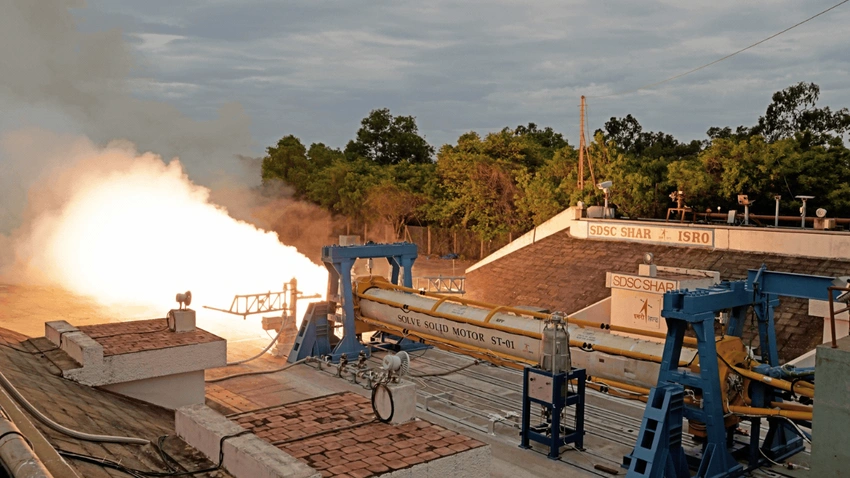
The Indian Space Research Organisation (ISRO) has marked a significant milestone for its ambitious Gaganyaan human spaceflight mission, successfully conducting the first ground test of the Sub-Orbital Launch Vehicle for Experiments (SOLVE) solid motor. This crucial test took place on July 3 at the Static Test Facility, Satish Dhawan Space Centre, Sriharikota, signaling a major step forward in India's journey to send humans to space.
The SOLVE solid motor is not just any rocket component; it's a dedicated test platform. Its primary purpose is to carry out Integrated Parachute Tests, which are vital for validating the deceleration system of the Gaganyaan mission’s Crew Module under various conditions. Ensuring the safe return of astronauts is paramount, and these tests are designed to perfect the process.
During these upcoming test missions, the SOLVE vehicle will launch the Crew Module to an altitude of 10 to 17 kilometers. Once at the target height, the module will separate from the vehicle, initiating the deployment of a series of 10 parachutes. These parachutes are engineered to progressively reduce the velocity of the Crew Module, preparing it for a gentle splashdown in the sea. This intricate sequence is critical for the safety and success of the crewed mission.
ISRO revealed that the SOLVE's solid stage has been cleverly adapted from the Polar Satellite Launch Vehicle (PSLV) Strap-on Motor. This adaptation involved several modifications to meet the specific requirements of the Gaganyaan test missions. Key changes include the development of a slow burn rate propellant and a straight nozzle equipped with secondary injection thrust vector control. The space agency confirmed that all motor performance parameters observed during the ground test were precisely as expected, indicating a successful outcome.
"The development of the SOLVE vehicle provides flexibility in conducting Gaganyaan Test Missions simulating various conditions in the actual mission," ISRO stated, highlighting the strategic importance of this new test platform. This flexibility will allow ISRO scientists and engineers to rigorously test and fine-tune every aspect of the crew module's return sequence, building confidence for the eventual human flight.
This latest achievement comes as part of a series of intensive preparations for the Gaganyaan programme. In recent months, ISRO has been busy with other critical tests, including the second Integrated Air Drop Test (IADT-02). Furthermore, a behavioral study named Mission MITRA (Mapping of Interoperable Traits and Response Assessment) was conducted in Leh, involving the four selected Indian astronauts along with scientists, engineers, and medical teams. These comprehensive efforts underscore India's commitment and meticulous approach to its human spaceflight aspirations, aiming for the first uncrewed mission soon.
