Why Money Heist Made Intelligence More Exciting Than Violence


Why Money Heist Made Intelligence More Exciting Than Violence
Why Money Heist Made Intelligence More Exciting Than Violence
What made Money Heist stand out globally was not simply that it told the story of a robbery. Television has long been filled with crime stories, hostage situations, and action-driven plots. What made Money Heist different was the way it shifted the center of excitement away from violence and placed it firmly on intelligence.
The series proved that viewers could be held in suspense not only by explosions, weapons, or physical confrontation, but by planning, anticipation, and the psychological tension of watching a brilliant strategy unfold under pressure.
At the center of this transformation is The Professor, one of the most memorable television characters in recent years. Unlike traditional crime masterminds who dominate through force, the Professor leads almost entirely through intellect. His strength lies in preparation, emotional control, observation, and the ability to predict human behavior.
This immediately changes how suspense works in the series.
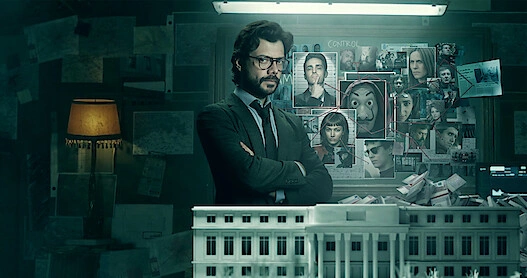
In many action dramas, tension builds around who will overpower whom. In Money Heist, tension often builds around whether the plan will hold when human unpredictability enters the equation. The audience is not waiting for someone to win through aggression; they are watching whether intelligence can survive chaos.
That difference makes every episode feel psychologically engaging.
The heist itself is designed less like a battle and more like a chess game. Every movement has consequences. Every conversation may contain hidden strategic value. Every mistake forces adaptation.
The Professor’s planning is fascinating because it is never presented as perfect certainty. Instead, it is shown as flexible intelligence: an ability to think ahead while still adjusting when reality changes.
This is what makes intelligence exciting in the show: it is active, not abstract.
The audience watches strategy under pressure, where timing matters as much as logic. A delayed decision, a broken emotional rule, or a moment of panic can threaten an entire operation. Suddenly, even quiet scenes become suspenseful because intelligence itself becomes dramatic.
Another reason Money Heist made intelligence more exciting than violence is that the series understands psychology deeply. The plan is not only about entering a building or printing money: it depends on managing fear, loyalty, negotiation, and perception.
The Professor repeatedly wins not because he has more force, but because he understands how others think.
He anticipates police reactions, media pressure, public emotion, and even internal weaknesses within his own team. He knows that controlling information often matters more than controlling space.
This transforms the conflict into something far more layered than a simple crime narrative.
The role of Raquel Murillo also strengthens this dynamic. As an investigator, she is not portrayed merely as opposition but as another intelligent force. Her interactions with the Professor become compelling because they are built on mutual intellectual recognition. The emotional tension between them works precisely because both characters understand strategy, which makes every exchange layered with hidden meaning.
Violence exists in Money Heist, of course, but it rarely feels like the most interesting part of the series.
The Professor is brilliant, but he is not untouched by fear. His intelligence becomes exciting because it operates under emotional risk. He makes mistakes, improvises, and sometimes nearly loses control when feelings enter spaces he had carefully organized.
That human element matters because it prevents strategy from becoming mechanical.
Ultimately, Money Heist succeeded because it understood that suspense does not require constant violence to remain powerful. Sometimes the most gripping moment is a silence before a decision, a phone call with hidden meaning, or a single move in a larger plan that viewers suddenly realize has enormous consequences.
The show turned thinking into spectacle.
And perhaps that is why it became so globally admired: it reminded audiences that intelligence, when placed under pressure, can be just as thrilling: if not more thrilling than violence itself.
