UNGA: Jaishankar Rips Into Pakistan Over Terrorism & Indus Waters

UNGA: Jaishankar Rips Into Pakistan Over Terrorism & Indus Waters
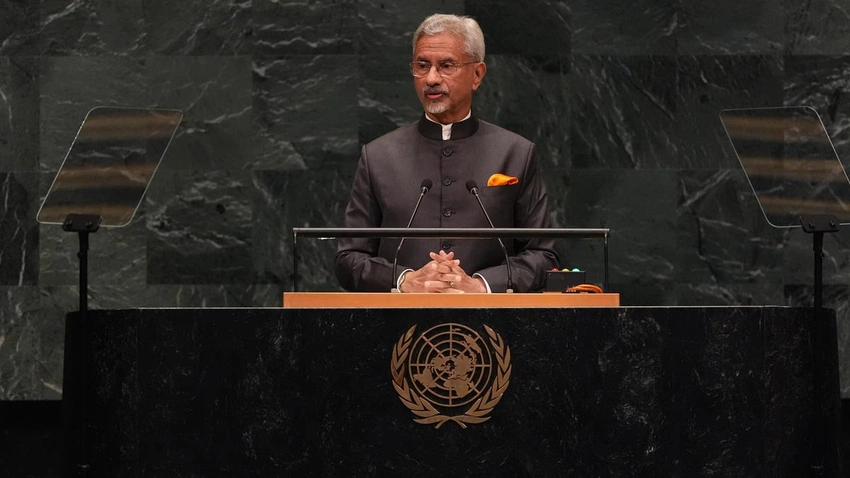
External Affairs Minister S. Jaishankar delivered a powerful statement at the UNGA, condemning Pakistan as a 'serial practitioner of terrorism' and linking any future normalization of ties to an end to terror activities.
External Affairs Minister S. Jaishankar delivered a powerful and unyielding address at the United Nations General Assembly (UNGA) on Saturday, where he directly confronted Pakistan on the issue of terrorism and challenged its Prime Minister's earlier remarks.
Speaking from the podium, Jaishankar branded Pakistan as a "serial practitioner of terrorism" and emphasized that there could be "no dilution" in the world's zero-tolerance approach to such acts.
Jaishankar's strong rebuttal came in response to Pakistan Prime Minister Shehbaz Sharif's speech on Friday, in which Sharif had accused India of human rights violations in Kashmir and criticized the BJP government. Jaishankar firmly stated that "Our right to defend ourselves against terrorism will be exercised," and asserted that governments engaged in state-sponsored terrorism with a "cross-border purpose" must be held accountable.
He also responded to Sharif's accusation that India was "weaponizing water" by holding the Indus Waters Treaty in abeyance. Jaishankar clarified India's position, stating that
Friendship and goodwill cannot co-exist with terrorism. Understandings premised on that will naturally be called into question,
suggesting that Pakistan's continued support for terrorism impacts the viability of such agreements.
This diplomatic exchange highlighted the deep-seated tensions between the two South Asian neighbours on the global stage.
Beyond the India-Pakistan dynamic, Jaishankar also touched upon broader global issues.
He spoke about the significant impact of ongoing conflicts, such as those in Ukraine and West Asia, on the Global South. He highlighted how countries far removed from these conflicts are being "penalized for no fault of theirs," particularly affecting the "Four Fs": Food, Fuel, Fertilizers, and Finance.
He also raised concerns about attacks on seafarers, noting that 18 Indians had been among those killed, and called for international action against such targeting. Regarding the Israel-Gaza conflict, Jaishankar reiterated India's belief in a two-state solution and its ongoing humanitarian efforts to provide relief to Palestinians.
Concluding his address, Jaishankar spoke about the evolving global order, noting that a multi-polar world is emerging and that the post-1945 order must adapt to "new realities." He advocated for an "intrinsically diverse world with a more democratic future" and made a strong pitch for reformed multilateralism, specifically calling for an expansion of the UN Security Council to make it more representative. This marked Jaishankar's fifth time delivering India’s National Statement at the UNGA, with Prime Minister Narendra Modi having skipped the event this year.
