Fashion's Culture Crossroads: Outrage, Authenticity, & Deep Roots

Fashion's Culture Crossroads: Outrage, Authenticity, & Deep Roots
Social media explodes over 'cultural appropriation' in fashion, but what happens when designs have a three-decade backstory? We're diving into the Fendi Baguette controversy and the true meaning of collaboration.
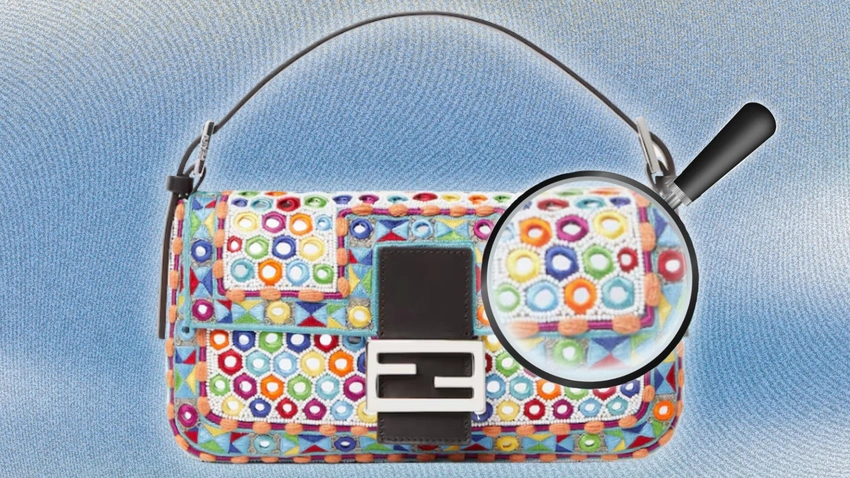
Social media has become a rapid-fire arena where fashion controversies ignite, often fueled by the quick label of “cultural appropriation.” Spotting a familiar cultural reference and adding those trigger words is almost guaranteed to generate content. The latest buzz? Fendi's vibrant, mirrorwork Baguette, drawing comparisons to Gujarati embroidery and India's festive visual language.
The resemblance is undeniable, and it's tempting to jump to conclusions.
However, what often gets lost in the digital noise is the deeper story behind the scenes.
And in the case of this Fendi Baguette, that missing context completely changes the conversation.
More Than Just a Bag
Fendi's Fall/Winter 2026, 27 Baguette is a marvel: 39,500 beads and 475 mirrors, all hand-embroidered over more than 138 hours, priced at $10,000. Its current product description calls it a re-edition of the house's 1997 Baguette, but tellingly, it makes no mention of India, Gujarat, Navratri, or Chanakya.
This silence is particularly problematic at a time when audiences are rightly pushing luxury houses to acknowledge the cultural sources behind designs that clearly echo local traditions.
We've seen this before. Prada faced criticism in 2025 for Kolhapuri-inspired sandals before acknowledging their Indian origins and later launching a 'Made in India' collaboration. More recently, Ralph Lauren also faced backlash over embroidery that commenters likened to Indian zardozi.
It's a legitimate conversation we need to keep having.
The Untold Decades-Long Story
Here's where Fendi's story diverges significantly. Maria Grazia Chiuri, now Fendi's creative director, first met Karishma Swali, the managing and creative director of Mumbai-based embroidery and textile house Chanakya International, in the early 1990s, when Chiuri was heading accessories at Fendi. Their creative partnership has flourished for over three decades.
There's an almost perfect irony to this situation.
Swali once highlighted a Fendi Baguette embroidered with mirrorwork from around 30 years ago as a specially significant object from their collaboration. This means mirrorwork bags have been part of their creative dialogue for a very long time, predating the current social media discourse.
Fendi didn't just 'discover' or 'borrow' this visual language overnight. The brand has a documented history of working with Indian embroidery practitioners that spans decades through Chanakya, which was founded in Mumbai in 1986. Chanakya has grown into a major embroidery and textile house, and its School of Craft, founded in 2016, has trained more than 1,400 women in craft-based education.
Collaboration vs. Appropriation: A Critical Distinction
There’s a world of difference between appropriation and genuine collaboration, even if the final product might look similar to an untrained eye. As the saying goes:
If a luxury house commissions craftspeople, pays for their expertise and works through an established organisation that supports their education and livelihoods, that is materially different from reproducing a traditional design without involving its makers.
This distinction doesn't give luxury brands an automatic pass, but it shifts the focus. The key questions should always be: Who made it? Who was involved?
And how was the relationship structured? In Fendi's case, the answer leads directly to Chanakya, a partnership built on years of mutual respect and creative development.
Perhaps it's time for brands to be more transparent about these long-standing relationships, and for us, the audience, to dig a little deeper before hitting 'share'. Doing our homework can enrich the conversation for everyone involved.

Login to comment.
No thots yet. Be the first to share your thoughts!