Huawei Unveils Upgraded Stellar AI Fabric for Next-Gen AI Computing

Huawei Unveils Upgraded Stellar AI Fabric for Next-Gen AI Computing
Discover Huawei's upgraded Stellar AI Fabric Solution, enhancing AI computing efficiency and reliability for data centers. Unveiled at HUAWEI CONNECT 2026, this innovation promises continuous uptime and maximum compute u
SHANGHAI, At the recent HUAWEI CONNECT 2026 event, Huawei took center stage to introduce its significantly upgraded Stellar AI Fabric Solution. This powerful new offering is designed to revolutionize how AI computing production networks operate, promising continuous uptime and maximum utilization of compute resources for the demanding world of artificial intelligence.
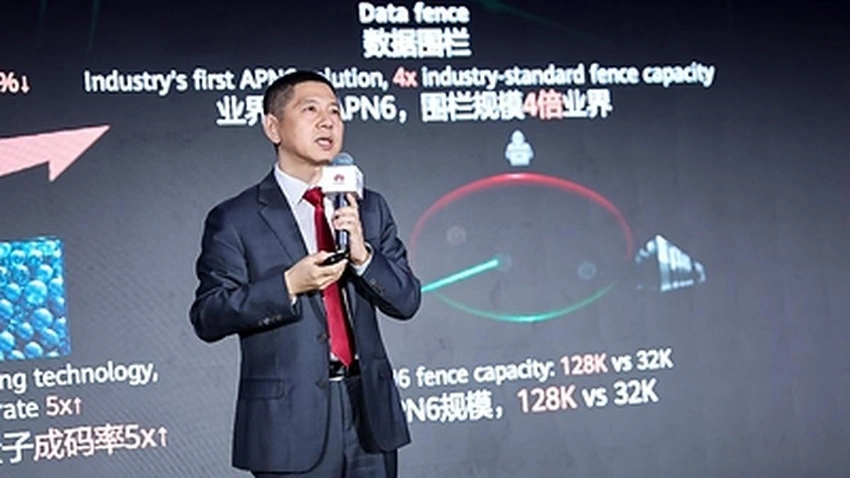
The event, themed "Leading AI DC Innovation, Shaping the Agentic World," brought together over 600 industry leaders and researchers. Erick Zhang, President of the Data Center Network Domain at Huawei Data Communication Product Line, emphasized the profound shift AI is causing, transforming traditional data centers into highly efficient "compute factories." He highlighted that in this new "agentic era," the underlying network fabric is crucial, directly impacting token throughput and overall compute yield.
To meet these escalating demands, the enhanced Stellar AI Fabric solution boasts a suite of advanced technologies. It integrates the robust Rock-Solid Architecture 2.0, the insightful StarryWing Digital Map 2.0, Hyper-Converged Fabric (HCF), and Network Packet Load Balancing (NPLB).
A standout feature is the upgraded NetMaster network AI agent, which can automatically identify and analyze the root cause of 95% of network faults within minutes, ensuring unparalleled production uptime.
Huawei also unveiled two innovative switch families built specifically for high-density computing environments.
The CloudEngine SF9300 (UBG switch) uses a two-layer multi-plane architecture, which can slash buildout costs by 30%.
Its simplified UB forwarding reduces end-to-end latency by an impressive 40%, while Link-Layer Retransmission (LLR) offers microsecond-level recovery to eliminate packet loss during link fluctuations, ensuring rock-solid reliability.
The CloudEngine XH9300 (NPO switch) delivers proprietary 100T and 51.2T capabilities. It features a centralized light source and a proprietary 3.2T Optical Engine (OE), significantly lowering interconnect power draw by 40%. By eliminating the optical DSP (oDSP) stage, this architecture cuts forwarding latency by 26%, and its snap-in pluggable optical engines simplify maintenance, speeding it up tenfold.
The impact of Huawei's innovations is already being felt across industries.
The Beijing FinTech Industry Alliance, in collaboration with Huawei and 17 partners, has released a new Technical Specification for Network High Availability of Financial Data Centers. This standard sets technical baselines and testing methods to ensure robust architectural redundancy, efficient fault recovery, and proactive prevention within critical financial networks.
In the realm of scientific research, Qi Fazhi, Computing Center Director at the Institute of High Energy Physics (IHEP), Chinese Academy of Sciences, reported remarkable results. Their deployment of the Stellar AI Fabric boosted computing efficiency by over 10%. This system effectively balanced training traffic across the network, ensuring unhindered throughput for massive telemetry data and dramatically accelerating deep-space signal analysis.
Huawei's ongoing commitment is to continue investing in intelligent data center networking alongside global partners, pushing the boundaries of next-generation compute infrastructure.
#HuaweiConnect2026 #AIcomputing #DataCenters #TechInnovation
