Occupancy Sensor vs Motion Sensor: Which One Is Right for Your Project?

Occupancy Sensor vs Motion Sensor: Which One Is Right for Your Project?
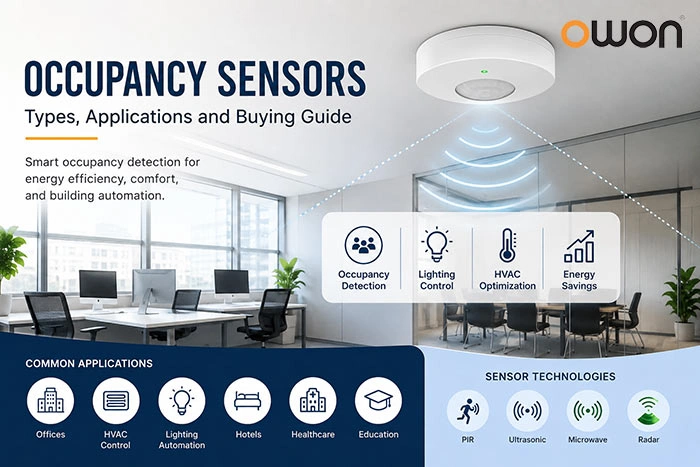
Learn what occupancy sensors are, how they work, the different sensor types, commercial applications, and how to choose the right occupancy sensor for smart building and HVAC automation.
Introduction
Modern commercial buildings are expected to provide comfortable indoor environments while minimizing energy consumption. However, lighting, HVAC systems, and other building equipment often continue operating even when spaces are unoccupied, leading to unnecessary energy waste and higher operating costs.
Occupancy sensors solve this challenge by automatically detecting whether a room is occupied and allowing building systems to respond accordingly. Instead of relying solely on fixed schedules or manual control, occupancy-based automation enables lighting, heating, cooling, and ventilation to operate only when needed.
Today, occupancy sensors are widely used in offices, hotels, hospitals, schools, retail stores, and smart buildings to improve energy efficiency, occupant comfort, and facility management.
This guide explains what occupancy sensors are, how they work, the different sensing technologies available, where they are commonly used, and how to choose the right occupancy sensor for commercial projects.
What Are Occupancy Sensors?
An occupancy sensor is an electronic device that automatically detects whether people are present in a specific area. The sensor sends occupancy information to connected systems, allowing equipment such as lighting, HVAC, ventilation, or security systems to operate more intelligently.
Unlike manual switches or fixed schedules, occupancy sensors respond to actual room usage. When occupants enter a room, connected systems can automatically activate. When the room becomes vacant, equipment can switch to an energy-saving mode or turn off after a preset delay.
Occupancy sensors play an important role in modern building automation because they help eliminate unnecessary energy consumption without requiring occupants to manually control building systems.
Typical applications include:
- Commercial office buildings
- Hotels and hospitality
- Healthcare facilities
- Educational buildings
- Retail stores
- Warehouses
- Smart homes
- Industrial buildings
As energy regulations become stricter and sustainability goals become more important, occupancy sensing has become a standard component of intelligent building design.
How Do Occupancy Sensors Work?
Although different technologies are available, most occupancy sensors follow the same basic operating process.
Step 1 — Detect Human Activity
The sensor continuously monitors its detection area using technologies such as infrared, ultrasonic waves, microwave signals, or millimeter-wave radar.
Depending on the sensing technology, the device may detect:
- Body movement
- Heat emitted by occupants
- Micro-movements such as breathing
- Changes in reflected radio waves
Step 2 — Determine Occupancy Status
The sensor analyzes the collected signals to determine whether the space is occupied or vacant.
Modern radar-based occupancy sensors can continuously detect human presence, even when occupants remain seated during meetings or focused work.
Step 3 — Send Control Signals
Once occupancy status has been determined, the sensor communicates with other building systems.
Depending on the installation, occupancy information may be sent to:
- Lighting controllers
- HVAC thermostats
- Ventilation systems
- Building Management Systems (BMS)
- Smart building gateways
- Security systems
Wireless communication protocols such as ZigBee, Wi-Fi, Bluetooth, and Matter have made occupancy sensors easier to deploy, especially in retrofit projects where additional wiring is undesirable.
Step 4 — Optimize Building Operation
The connected control system adjusts equipment automatically based on occupancy status.
For example:
- Lights turn off after occupants leave.
- Air conditioning switches to energy-saving mode.
- Ventilation adjusts according to room usage.
- Smart building platforms collect occupancy data for facility optimization.
This automated approach helps improve both energy efficiency and occupant comfort while reducing manual intervention.
Why Occupancy Sensors Matter in Modern Buildings
Occupancy sensors are no longer limited to automatic lighting control. Today they have become a key component of intelligent building automation.
Their benefits include:
- Reducing unnecessary energy consumption
- Improving occupant comfort
- Supporting HVAC optimization
- Enhancing building automation
- Lowering operating costs
- Helping buildings achieve sustainability goals
- Providing occupancy data for smarter facility management
For commercial buildings managing hundreds or even thousands of rooms, occupancy sensing provides valuable real-time information that enables more efficient operation across multiple building systems.
Types of Occupancy Sensors
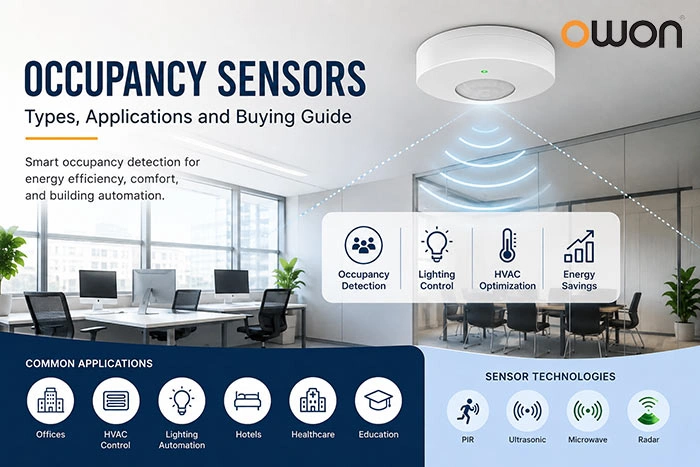
Occupancy sensors use different sensing technologies to detect whether a space is occupied. Each technology has its own advantages and is suitable for different commercial applications.
Understanding these technologies helps engineers, system integrators, and facility managers select the most appropriate solution for their building automation projects.
Passive Infrared (PIR) Sensors
Passive Infrared (PIR) sensors are the most widely used occupancy sensors. They detect changes in infrared energy emitted by the human body.
PIR sensors work well in environments where occupants are frequently moving, making them a common choice for lighting control in offices, corridors, restrooms, and storage areas.
Advantages
- Cost-effective
- Low power consumption
- Easy to install
- Suitable for basic occupancy detection
Limitations
- Cannot reliably detect stationary occupants
- Performance may decrease if movement is minimal
- Less suitable for continuous HVAC occupancy control
Ultrasonic Occupancy Sensors
Ultrasonic sensors emit high-frequency sound waves and analyze their reflections to detect movement within a space.
Because they can detect relatively small movements, ultrasonic sensors are often installed in enclosed rooms where occupants may move less frequently.
Advantages
- Better detection of small movements than PIR
- Suitable for enclosed spaces
- Good coverage around obstacles
Limitations
- May trigger false detections in some environments
- Performance can be influenced by airflow or moving objects
Microwave Occupancy Sensors
Microwave sensors transmit electromagnetic waves and detect occupancy by measuring changes in the reflected signals.
They provide larger detection coverage than PIR sensors and can detect movement through certain non-metallic materials.
Advantages
- Long detection range
- Wide coverage
- Suitable for larger spaces
Limitations
- Higher power consumption
- More sensitive to unwanted movement
- May require careful installation to avoid false triggers
Radar Occupancy Sensors
Radar occupancy sensors use millimeter-wave (mmWave) radar technology to continuously monitor human presence.
Unlike traditional motion sensors, radar sensors can detect subtle micro-movements such as breathing or slight posture changes. This allows them to recognize occupants even when they remain seated for extended periods.
Because of this capability, radar sensors have become increasingly popular in commercial HVAC control, smart offices, healthcare facilities, and intelligent building automation.
Typical advantages include:
- Continuous occupancy detection
- High detection accuracy
- Reduced false vacancy events
- Excellent performance for HVAC automation
- Suitable for modern smart building applications
For example, a ZigBee Occupancy Sensor 🔗 combines radar-based occupancy detection with low-power wireless communication, allowing seamless integration into building automation platforms without additional control wiring. Solutions such as the OWON OPS305 are designed for commercial applications where accurate occupancy awareness is essential for HVAC optimization and smart building control.
Occupancy Sensor vs Motion Sensor
These two terms are often used interchangeably, but they are not exactly the same.
A motion sensor primarily detects movement. Once movement stops, the sensor may assume the room is vacant after a preset timeout.
An occupancy sensor is designed to determine whether people are actually present. Modern occupancy sensors—particularly radar-based models—can continue detecting occupants even when they remain relatively still.
This distinction is especially important for commercial HVAC systems.
For example, during a one-hour meeting, participants may remain seated with minimal movement. A traditional motion sensor could mistakenly indicate that the room is empty, causing the HVAC system to reduce heating or cooling before the meeting has ended.
A radar occupancy sensor continues monitoring human presence throughout the meeting, allowing the HVAC system to maintain a comfortable indoor environment.
<table><tbody><tr><td data-row="1">FeatureMotion SensorOccupancy Sensor</td></tr><tr><td data-row="2">Detects Movement</td><td data-row="2">✓</td><td data-row="2">✓</td></tr><tr><td data-row="3">Detects Stationary Occupants</td><td data-row="3">Limited</td><td data-row="3">✓</td></tr><tr><td data-row="4">Suitable for Lighting Control</td><td data-row="4">Excellent</td><td data-row="4">Excellent</td></tr><tr><td data-row="5">Suitable for HVAC Automation</td><td data-row="5">Moderate</td><td data-row="5">Excellent</td></tr><tr><td data-row="6">Reduces False Vacancy Events</td><td data-row="6">Moderate</td><td data-row="6">Excellent</td></tr><tr><td data-row="7">Smart Building Applications</td><td data-row="7">Good</td><td data-row="7">Excellent</td></tr></tbody></table>As commercial buildings adopt more intelligent HVAC and energy management strategies, occupancy sensors are increasingly replacing traditional motion sensors in applications where accurate presence detection is required.
Common Applications of Occupancy Sensors
Occupancy sensors are used across a wide range of commercial and residential environments. By automatically detecting room occupancy, they help improve energy efficiency, occupant comfort, and building automation while reducing unnecessary equipment operation.
Below are some of the most common applications.
Air Conditioning and HVAC Control
Heating and cooling systems account for a significant portion of a building’s energy consumption. Traditional HVAC systems often rely on fixed schedules, which may continue conditioning empty rooms long after occupants have left.
Occupancy sensors enable HVAC systems to adjust heating, cooling, and ventilation according to real-time room occupancy. This occupancy-based control helps reduce unnecessary HVAC runtime while maintaining comfortable indoor conditions when spaces are in use.
Radar-based occupancy sensors are particularly effective in meeting rooms, private offices, hotel guest rooms, classrooms, and healthcare facilities, where occupants may remain seated for extended periods.
Lighting Control
Lighting remains one of the most common applications for occupancy sensors.
Instead of relying on manual switches, lights can automatically turn on when occupants enter a room and switch off after the space becomes vacant.
Typical applications include:
- Offices
- Meeting rooms
- Corridors
- Restrooms
- Warehouses
- Storage rooms
- Parking garages
Automatic lighting control improves convenience while reducing unnecessary electricity consumption.
Office Buildings
Modern office environments have highly dynamic occupancy patterns. Employees frequently move between workstations, meeting rooms, collaboration spaces, and common areas throughout the day.
Occupancy sensors help building operators optimize HVAC and lighting performance based on actual room usage rather than fixed schedules.
Combined with Building Management Systems (BMS), occupancy data can also support workspace utilization analysis, helping organizations make better decisions about office layouts and facility planning.
Hotels and Hospitality
Hotels continuously seek ways to reduce energy costs without compromising guest comfort.
Occupancy sensors allow guest room HVAC and lighting systems to automatically switch between comfort mode and energy-saving mode based on actual occupancy.
Unlike key-card systems that only detect whether a card is inserted, modern radar occupancy sensors can determine whether guests are actually present inside the room, providing more intelligent energy management.
Healthcare and Assisted Living
Hospitals, clinics, rehabilitation centers, and assisted living facilities require reliable occupancy detection to maintain comfortable indoor environments while minimizing unnecessary energy use.
Occupancy sensors can support HVAC control in patient rooms, consultation rooms, waiting areas, and staff offices, helping improve operational efficiency without affecting occupant comfort.
How to Choose the Right Occupancy Sensor
Choosing the right occupancy sensor depends on the application, sensing technology, and system integration requirements rather than simply selecting the lowest-cost option.
When evaluating occupancy sensors for commercial projects, consider the following factors.
Detection Technology
Different technologies offer different levels of occupancy accuracy.
For applications involving continuous occupancy, such as offices, meeting rooms, classrooms, or commercial HVAC systems, radar-based occupancy sensors generally provide more reliable performance than motion-only technologies.
Communication Protocol
Modern occupancy sensors are available with various communication options, including ZigBee, Wi-Fi, Bluetooth, and wired interfaces.
For commercial building automation projects, ZigBee occupancy sensors are widely used because they offer low power consumption, reliable mesh networking, and easy integration with smart building platforms, HVAC controllers, and lighting systems.
Integration Capability
A good occupancy sensor should integrate easily with the building’s existing control infrastructure.
Compatibility with smart thermostats, HVAC controllers, Building Management Systems (BMS), Energy Management Systems (EMS), and IoT gateways simplifies deployment and future expansion.
Commercial Reliability
Commercial buildings require occupancy sensors capable of operating continuously for many years.
When selecting products, system integrators should consider wireless stability, long-term product availability, firmware support, and OEM customization capabilities.
For example, the OWON OPS305 ZigBee Occupancy Sensor 🔗 combines millimeter-wave radar sensing with ZigBee 3.0 communication, making it suitable for commercial HVAC automation, smart offices, hotels, and broader building automation projects. It can also be integrated into OEM and ODM solutions for customers requiring customized hardware or software.
Frequently Asked Questions
What is an occupancy sensor?
An occupancy sensor is a device that detects whether people are present in a space and automatically controls connected systems such as lighting, HVAC, or ventilation to improve energy efficiency and occupant comfort.
What is the difference between an occupancy sensor and a motion sensor?
A motion sensor detects movement, while an occupancy sensor determines whether people are actually present. Radar-based occupancy sensors can continue detecting stationary occupants, making them more suitable for HVAC and smart building automation.
What types of occupancy sensors are available?
The most common types include Passive Infrared (PIR), Ultrasonic, Microwave, and Radar occupancy sensors. Each technology offers different advantages depending on the application.
Where are occupancy sensors commonly used?
Occupancy sensors are widely used in offices, hotels, hospitals, schools, warehouses, retail stores, smart homes, and commercial buildings for lighting control, HVAC automation, and energy management.
Are ZigBee occupancy sensors suitable for commercial buildings?
Yes. ZigBee occupancy sensors are widely used in commercial buildings because they provide reliable wireless communication, mesh networking, and easy integration with building automation systems.
Conclusion
Occupancy sensors have become an essential component of modern smart buildings by enabling lighting, HVAC, and other building systems to respond to actual room occupancy instead of fixed schedules. Whether the goal is reducing energy consumption, improving occupant comfort, or supporting intelligent building automation, selecting the appropriate sensing technology is critical.
Among the available technologies, radar-based occupancy sensors offer significant advantages for applications where continuous presence detection is required, particularly in offices, hotels, healthcare facilities, and commercial HVAC systems.
For organizations seeking wireless occupancy sensing, ZigBee occupancy sensors provide an efficient and scalable solution for smart building integration. For example, the OWON OPS305 combines millimeter-wave radar technology with ZigBee 3.0 connectivity, making it suitable for commercial HVAC automation, intelligent lighting control, and OEM or ODM building automation projects.
