Trump renews Greenland bid at Davos, calls postwar deal 'stupid'

Trump renews Greenland bid at Davos, calls postwar deal 'stupid'
Trump pushes for immediate talks on Greenland, framing Arctic security as the core motive while criticizing the WWII handover.
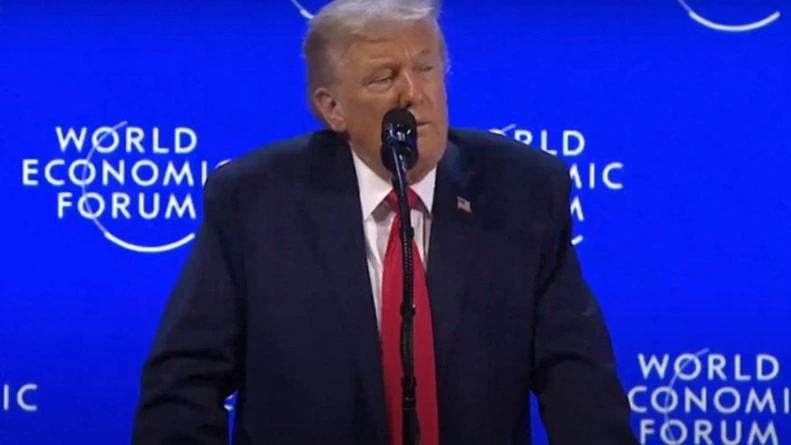
US President Donald Trump reignited a decades-old controversy about Greenland during a high-profile address at the World Economic Forum in Davos on Wednesday. He questioned the postwar decision to return the Arctic territory to Denmark and reiterated a long-standing interest in acquiring it for strategic reasons. 'We gave back Greenland to Denmark after WWII -- how stupid,' Trump said, arguing that no other nation is better positioned than the United States to secure the vast Arctic land. He described Greenland as 'a big piece of ice' in a very harsh, almost uninhabitable landscape, yet he framed its location as critical to security, lying between Russia, China and the United States.
Trump tried to downplay mineral wealth, acknowledging rare earth elements but insisting that 'that’s not the reason' for pursuing Greenland. Instead, he framed the bid as a security imperative, insisting, 'The US alone can protect this giant piece of ice, so that it is safe for Europe and for us.' He argued that bringing Greenland under U.S. protection would not threaten NATO, but would 'greatly enhance the security of the entire alliance' and push the United States to lead in Arctic defense as global power dynamics shift.
The former president also took aim at Denmark, calling the country 'ungrateful' for what he cast as long-standing U.S. protection during World War II. He stressed that Greenland's current undefended status is an issue in a world where threats are evolving and technology is changing how power is projected. In a nod to diplomacy, Trump signaled 'immediate negotiations' with Denmark to discuss the acquisition of Greenland by the United States, while insisting he would not resort to force. The remarks reflect a broader argument that diplomacy and strategic posture should be aligned to ensure security rather than short-term economic calculations.
While Davos is a venue for grand ambitions, the moment also mirrors a wider geopolitical tug-of-war. The debate over Greenland has spilled into trade as well: European lawmakers have suspended parts of a U.S.-EU trade deal over tariff tensions linked to the Greenland question, highlighting how Arctic geopolitics can affect economic ties. Observers say the exchange underscores a real shift in Arctic policy where security considerations sit at the core of any future arrangement and alliances.
Experts say the remarks could recalibrate how allies think about defense commitments and resource access in the Arctic. If negotiations proceed, the process could set a precedent for bilateral talks around sovereignty in one of the planet’s most sensitive frontiers. For now, Davos 2026 has again become a stage where security and strategy collide with diplomacy, economics, and climate realities in the race for Arctic influence.
