The AI Fiction Paradox: Does Knowing the Author Spoil the Story?

The AI Fiction Paradox: Does Knowing the Author Spoil the Story?
AI-generated stories can fool us, but a fascinating paradox emerges when we discover the truth. Does knowing an AI wrote it truly ruin the magic of a narrative?
The Unmasking Moment
It's a curious phenomenon, isn't it? An AI crafts a story, a poem, or even a compelling article, and readers are genuinely captivated. They're moved, they're entertained, they're engrossed.
Everything's going swimmingly until… the big reveal . Suddenly, the magic evaporates. The captivating narrative, previously indistinguishable from human work, loses its luster simply because we know a machine generated it.
It's about a deeper, more fundamental aspect of human perception.
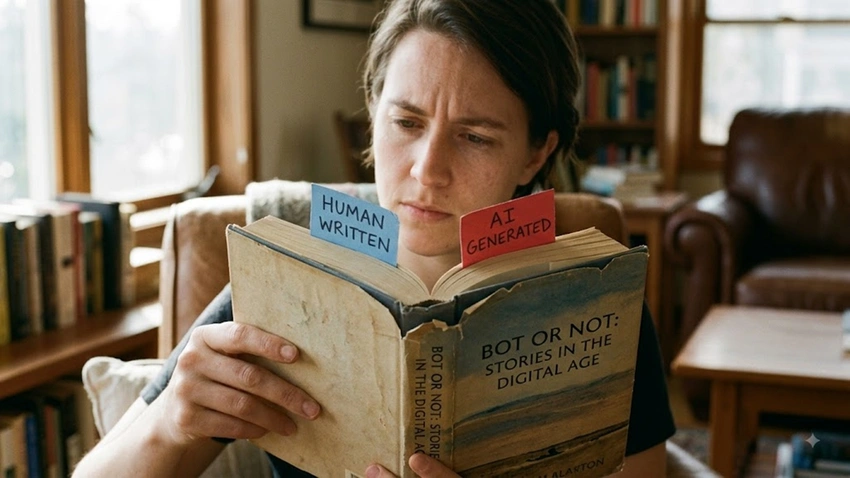
We've observed that AI-written stories can fool readers just fine, yet it's the knowledge of AI authorship that ruins the experience. What gives?
The Human Connection Deficit
At its core, storytelling has always been a profoundly human endeavor. When we read a book, watch a film, or listen to a song, we unconsciously seek a connection with the creator. We project our empathy, our understanding of human experience, and our appreciation for shared emotions onto the artist.
We interpret artistic choices as reflections of a human mind, its struggles, triumphs, and unique perspectives.
An AI, for all its sophistication, lacks consciousness, lived experience, and genuine emotion. It doesn't feel the pang of heartbreak, the joy of discovery, or the burning desire to share a specific truth. It processes data, identifies patterns, and generates text based on learned probabilities.
When we learn the 'author' is an algorithm, that vital human connection, that perceived artistic intent, is instantly severed.
The story transforms from a heartfelt expression into a clever mimicry.
The 'Magic' of Authorship
The 'magic' in storytelling often stems from the belief that there's a soul behind the words, a mind grappling with ideas, a heart pouring out emotion. It's the implicit understanding that another human being, much like ourselves, chose every word, crafted every metaphor, and sculpted every plot twist with purpose and passion.
This belief elevates the narrative beyond mere information delivery; it makes it an act of communication between sentient beings.
When that belief is shattered, even the most eloquently written AI tale can feel hollow. It becomes an impressive technical feat, perhaps even an interesting experiment, but rarely a deeply moving one. The wonder shifts from 'how did they think of that?' to 'how did the algorithm manage that pattern recognition?' It's a subtle but significant mental reframing that impacts our emotional engagement.
What Does This Mean for AI in Creative Fields?
This paradox presents a fascinating challenge for the integration of AI into creative industries.
If AI is to become a true partner, or even a recognized 'author,' it must somehow bridge this perceptual gap.
Is it possible for humans to eventually accept AI-generated content on its own merits, without prejudice about its origin?
Or will the demand for the 'human touch' always prevail, relegating AI to a sophisticated tool rather than a co-creator?
The answer might lie not in AI trying to be human, but in redefining our relationship with creative output. As AI tools become increasingly prevalent, perhaps we'll learn to appreciate their unique forms of 'authorship' or focus purely on the narrative's impact, regardless of source. For now, however, the human mind's need for an empathetic creator seems to be the biggest hurdle for AI-driven fiction to truly capture hearts, not just minds.
