Prada and It's Relation to Fascism and Fashion

Prada and It's Relation to Fascism and Fashion
Prada and It's Relation to Fascism and Fashion
Exploring how Prada's 1988 Milan debut used stark, conservative tailoring to carry memory—and how such aesthetics can subvert history. A critical read of fashion, power, and memory.
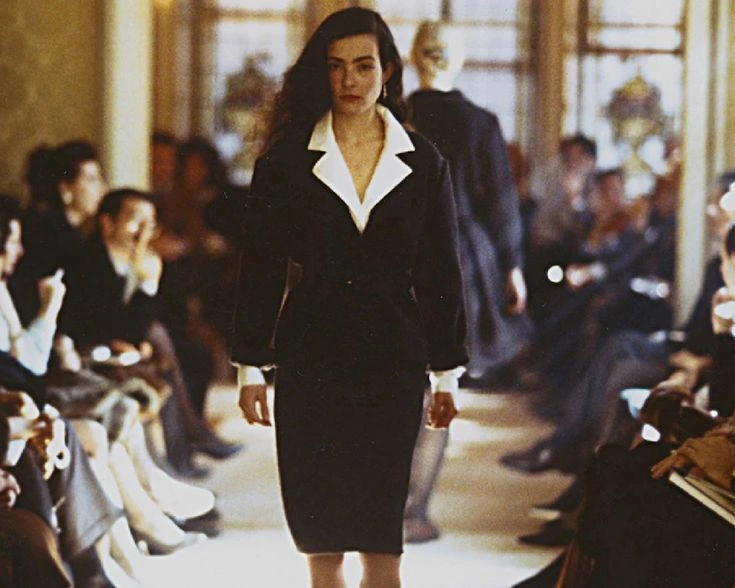
Before anything else: discussing fascism in relation to fashion is not endorsement. It is excavation. Prada, Miuccia Prada, and anyone seriously studying this history are not pro-fascism. The point is to understand how aesthetics carry memory and how they can subvert it. When Miuccia Prada presented her first womenswear collection in Milan for Autumn/Winter 1988, it did not look revolutionary. At first glance, it looked conservative. Severe. Almost stubbornly plain. But that surface restraint is precisely where the argument begins.
1988: The Shock of the Conservative
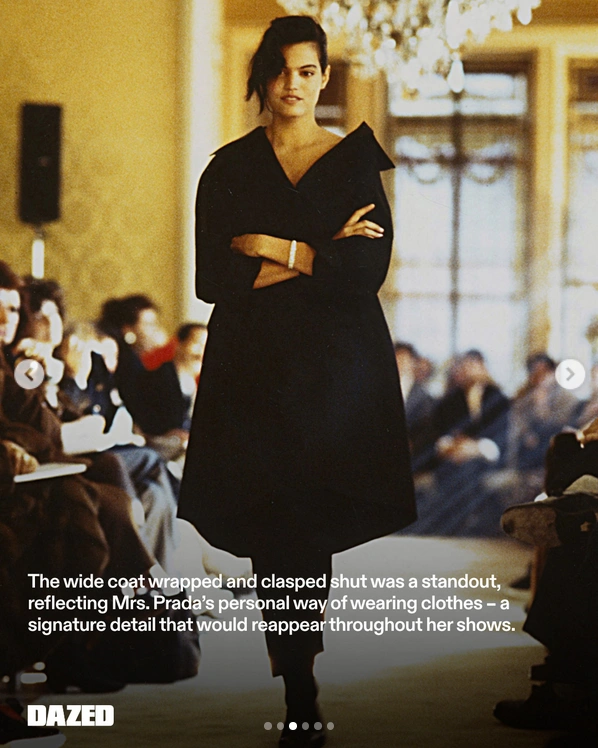
The debut show consisted of around seventy looks. Prada, until then known primarily for leather goods, stepped into clothing with sharp tailoring, knee-length skirts, sober coats, cardigans, and menswear-inspired silhouettes for women. Bags were present but not dominant. This was not glamour for glamour’s sake.
At that moment in Milan, designers such as Gianni Versace were pushing overt sensuality, bright, body-conscious, optimistic femininity. Prada offered something else: muted palettes, masculine slacks, modest skirts. No obvious seduction. No theatrics.
It felt strangely conservative. And yet, that conservatism was doing something complicated.
The Political Biography of a Designer
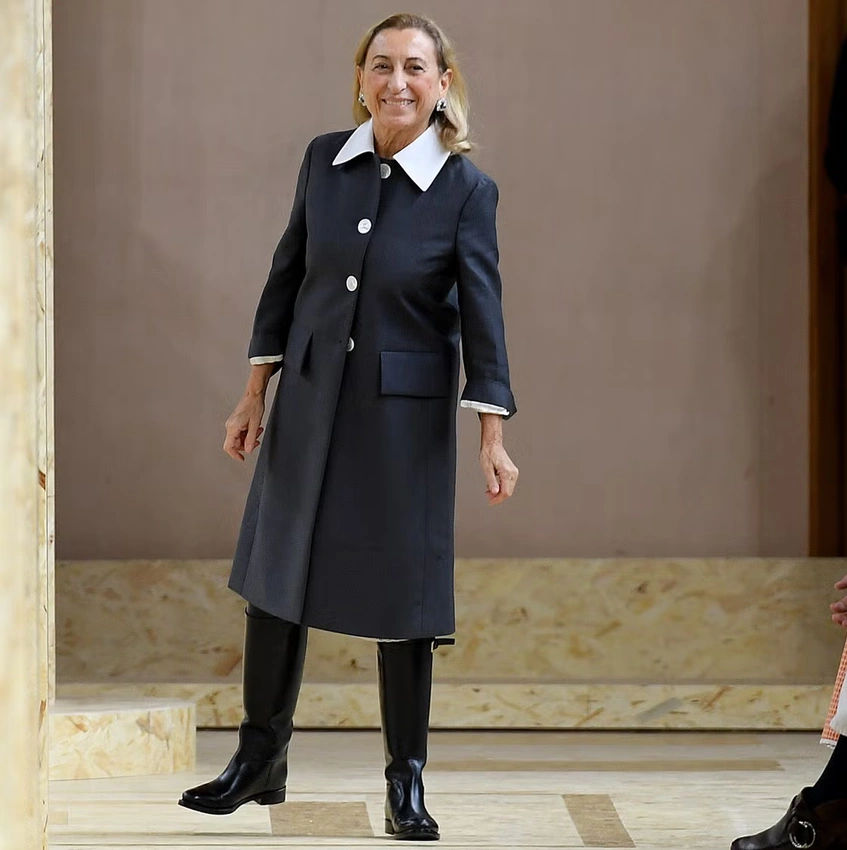
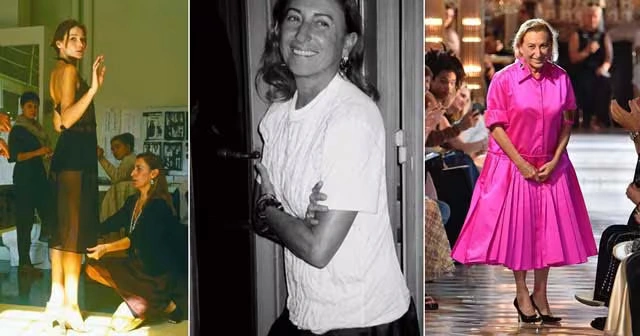
Miuccia Prada holds a doctorate in political science. She was involved with the Italian Communist Party and the Union of Italian Women. Unlike much of the fashion industry which often performs apolitical detachment politics mattered to her.
That matters when we read the clothes. To understand the symbolism of that 1988 collection, one must revisit Italy between 1922 and 1943 under Benito Mussolini. Fascism did not merely control the state; it sought to control identity, labour, gender roles even dress.
Uniforms, Class, and “Cooperation”
Mussolini’s regime promoted what it called “class cooperation”; a hierarchical vision in which inequality was framed as necessary for national strength. Individual identity was subsumed into proximity to the state. Uniforms became visual shorthand for this ideology.
The black shirts of the paramilitary squads were unmistakable: black shirt, black tie, black jacket a rigid aesthetic of authority. If you saw it coming toward you, it did not signal freedom.
Now consider Prada’s early collections. Military references recur: structured jackets, dark palettes, utilitarian silhouettes. Critics like Suzy Menkes sometimes described her work as “fascist” in tone. But that reading flattens the nuance.
Prada did not replicate the uniform. She destabilised it.
In one striking example, a jacket reminiscent of fascist military tailoring is subtly altered. Where a soldier’s chest pockets emphasised exaggerated pectoral strength machismo sculpted into fabric Prada’s interpretation curves differently, suggesting breasts instead of pecs. The symbol of hyper-masculine authority is feminised. It becomes almost ironic.
Women Under Fascism
In 1935, Mussolini established the National Fashion Board to “Italianise” women’s dress. High heels were encouraged. Conservative silhouettes were praised. French terminology was replaced with Italian equivalents. Beauty standards were officially promoted disturbingly specific ones.
After the First World War, many Italian women had adopted practical, tomboyish styles: shorter skirts, flat shoes, cropped hair. They had worked in factories, managed households, and embraced a sense of autonomy. Fascism pushed back. Femininity was to be controlled, softened, disciplined.
Now return to 1988 Prada.
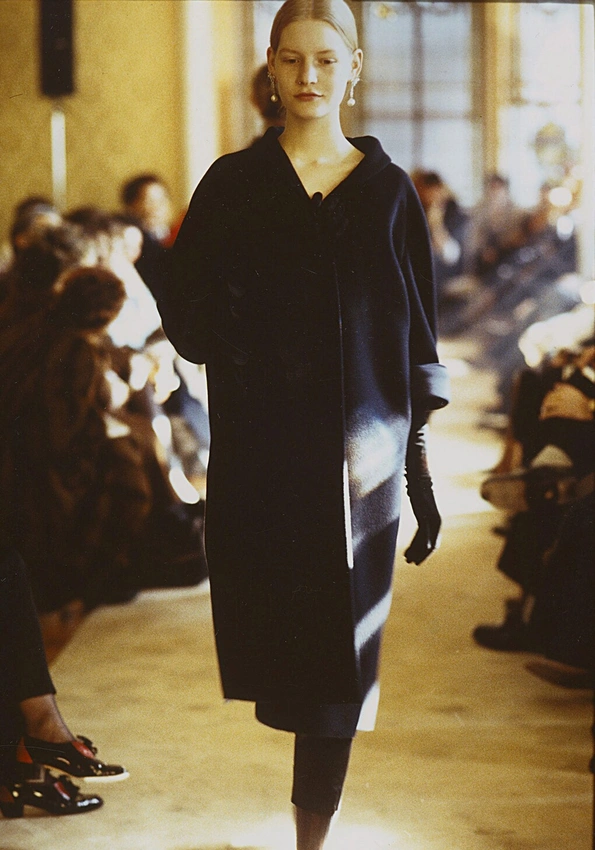
Flat shoes dominate the runway often clunky, practical, even unfashionable by late-1980s standards. Many feature Vibram soles, from an Italian company founded in 1937. The irony is sharp: Italian materials, Italian manufacturing, yet deployed in defiance of the regime’s vision of womanhood.
At a time when stilettos ruled, Prada presented brogues.
Neo-Realism and the 1950s
The collection also draws from Italian neo-realist cinema; the post-war film movement that focused on working-class lives and the moral wreckage left by fascism. Films such as Rome, Open City depicted uniforms, scarcity, and resilience with sober restraint.
Prada’s 1988 silhouettes of knee-length skirts, cardigans, modest tailoring evoke the late 1940s and early 1950s. Imagine women who had lived through fascism, then through war, then through defeat. What would they wear in 1950? Perhaps the same skirt suit but unbuttoned slightly. Paired with comfortable shoes. Less rigid. Less afraid.
The show seems to imagine that moment of ambiguity: when no one is telling you what to wear anymore, but the memory of being told lingers.
Class on the Runway
Another crucial element is class. Northern and southern Italian archetypes appear side by side: domestic workers, military references, bourgeois tailoring, rural echoes. Instead of reinforcing hierarchy, the runway flattens it. Every look is elevated to equal aesthetic status.
Where fascism insisted on order and stratification, Prada stages simultaneity. A uniform is no longer solely a marker of submission to the state; it becomes a garment among garments.
Ugly, or Honest?
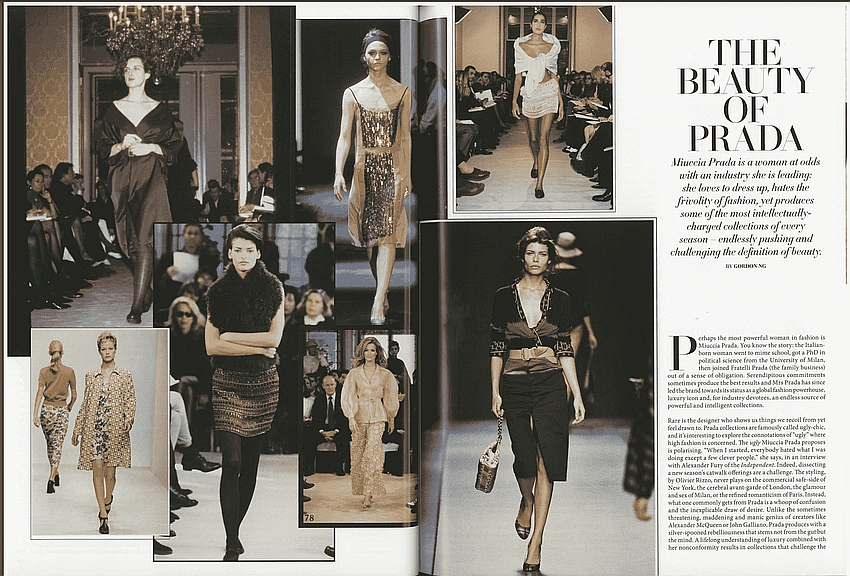
Prada’s early work was sometimes labelled “ugly chic.” She herself resisted that term. What critics called ugly was often simply unflattering, skirts slightly too long, shapes slightly awkward. But unflattering to whom? To the male gaze? To authoritarian ideals of symmetry and control?
Making the “ideal” less ideal is itself political.
To interpret this collection as pro-fascist because it references fascist aesthetics would be like calling satire endorsement. The garments operate as visual double entendres. They quote the past in order to unpick it.
Under an Italian name, using Italian materials, produced in Italy, Miuccia Prada constructs a quiet rebellion. She undermines Mussolini’s obsession with class hierarchy, military reverence, and rigid femininity decades after his death.
The 1988 collection is not loud. Instead, it rearranges symbols so subtly that the critique could pass unnoticed. Which may be the sharpest critique of all.
Fashion often pretends to float above politics. Prada’s debut suggests the opposite: that clothing remembers. And that memory, when handled carefully, can become resistance.
#Prada #MiucciaPrada #FashionHistory #1988Milan #ConservativeAesthetics
