"Hands Off!" Europe Rejects Trump's Call to Quit the ICC

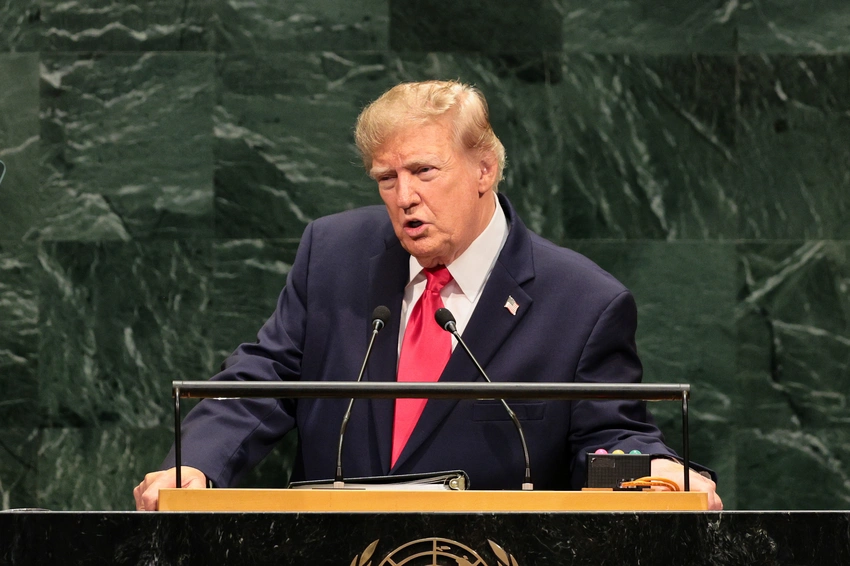
"Hands Off!" Europe Rejects Trump's Call to Quit the ICC
European leaders firmly reject Donald Trump's call for nations to withdraw from the International Criminal Court. They vow to uphold international justice, emphasizing accountability for war crimes. Get the full story!
European leaders are standing firm behind the International Criminal Court (ICC), delivering a resounding rejection of former President Donald Trump's recent call for nations to "immediately" resign from the organization. Trump's push is part of a broader U.S. effort to dismantle the court, which he labels a "rogue institution."
Irish Taoiseach (Prime Minister) Micheál Martin publicly pledged his nation's support for the ICC during his speech at the United Nations General Assembly in New York. He stated that Ireland "strongly opposes efforts to undermine the court" and emphasized that Russia must be held "accountable" for its actions in Ukraine.
Martin declared,
There can be no impunity for war crimes… that is why Ireland is a steadfast supporter of the International Criminal Court,
demanding that all "measures against it should be immediately withdrawn."
Echoing this sentiment, Netherlands Prime Minister Rob Jetten defended the Hague-based court earlier, stating that the court has come "under attack." Without directly naming Trump or the U.S., Jetten questioned, "how can anyone possibly be opposed to prosecuting the very worst crimes?" He concluded with a clear message: "To say: 'hands off' the ICC, and all those other institutions that protect the international legal order." His remarks were met with loud applause from delegates.
The ICC is widely recognized as the world's highest criminal court, deriving its authority from the Rome Statute, a treaty ratified by 125 countries since its inception in 2002. Notably, neither the United States nor Israel is a state party to the Rome Statute, and therefore they do not recognize the court's jurisdiction.
Trump has consistently argued that the ICC oversteps its authority and should not claim jurisdiction over U.S. citizens. His recent appeals culminated in a public address at the U.N. where he called
on all nations that are members of the ICC to officially resign from this rogue institution, immediately.
He asserted that the U.S.
"will never allow U.S. service members or anyone else to be investigated or given show trials by an anti-American tribunal with no jurisdiction over us."
His demand was swiftly dismissed by German Foreign Minister Johann Wadephul, who told Deutschlandfunk radio, "We will, of course, not be doing that." Wadephul highlighted the ICC as "an important institution," acknowledging a "regrettable difference in policy from the U.S. Administration" on the matter.
Similarly, European Council president Antonio Costa affirmed that the E.U. stands "firmly behind" the ICC, stating it is "unacceptable to threaten or attack the International Criminal Court, its officials, and its staff."
At the U.N. assembly, the only nation to align with Trump's stance appeared to be Naoero, a microstate island country formerly known as Nauru. Naoero President David Adeang announced his country's formal withdrawal from the Rome Statute, citing the ICC's "increasing irrelevance." This move was praised by U.S.
Assistant Secretary for East Asian and Pacific Affairs Michael DeSombre, who stated that Naoero
joins a growing number of nations standing up for their sovereignty against the ICC's illegitimate overreach.
However, experts caution that leaving the ICC is neither an immediate nor a clean break. According to Sergey Vasiliev, a professor of international law, withdrawal takes at least a year, and states remain obligated to cooperate with proceedings initiated before their departure. A state must file a notification, and the withdrawal comes into effect one year after that notification is received.
