The Radical Power of Punctuation: A Story From 1905 Russia

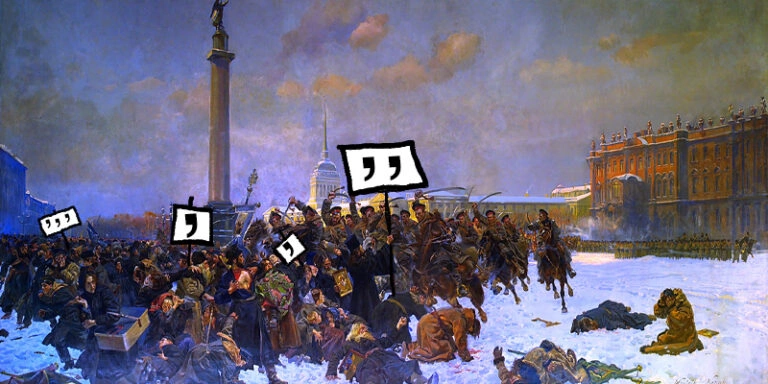
The Radical Power of Punctuation: A Story From 1905 Russia
Discover how a seemingly minor dispute over commas sparked a revolution in 1905 Russia, changing the course of history and proving every detail of labor is consequential.
Ever think a tiny mark could topple an empire? Punctuation, those seemingly insignificant squiggles on a page, holds immense power. We've all seen the hilarious, and sometimes terrifying, difference a comma can make - 'eats shoots and leaves' versus 'eats, shoots and leaves', or the infamous 'I ate, grandma' versus 'I ate grandma'.
But imagine these tiny symbols sparking a revolution.
That's exactly what happened in Russia over a century ago.
In 1905, unrest was brewing across the vast Russian Empire, with peasants, workers, and soldiers rising against brutal repression. Amidst this turmoil, a seemingly minor labor dispute ignited a seismic political shift.
The unsung heroes?
Printers at Sytin's Moscow publishing house.
These skilled workers were paid by the letter they set, a common practice at the time. The catch? Punctuation, despite requiring the same precise effort and time, wasn't included in their pay.
As Florence Hazrat highlights in her piece, A history of punctuation for Aeon, these Moscow printers
demanded to be paid for setting not only letters but also punctuation marks, which required the same action and the same amount of time as the alphabet.
It was about the fundamental value of their labor. What began as a simple demand for fair compensation quickly escalated into what became known as the “Comma Strike.” This localized dispute at Sytin's wasn't isolated for long. It resonated deeply with other workers, sparking solidarity and a widespread popular boycott throughout the country.
The impact was swift and dramatic. As Feliks Gross details in his 1950s academic article, The Strike and The Revolution , “The October uprising of the 1905 revolution was triggered by an economic strike.
The printers in a Moscow shop struck, because they were not paid for commas, semi-colons and periods, in a word, for punctuation.” A subsequent railroad strike, fueled by the printers' bold action, quickly spread and transformed into a powerful, general political protest.
Think about that, the commas that started a revolution. This chain of events ultimately forced the czar to cede Russia its first constitution, a monumental shift towards a constitutional monarchy. It's a powerful, post-Labor Day reminder that every bit of labor, no matter how small or seemingly trivial, is consequential.
The Unseen Architects of Change
This historical footnote offers a crucial lesson for today's world. It shows us that true power can emerge from unexpected places, from the seemingly smallest components of our work and communication.
It underlines how fundamental principles of fairness and respect for labor can, and do, drive historical change.
So, next time you casually drop a comma, remember its revolutionary past.
Every detail matters, and sometimes, those details can reshape history.

Login to comment.
No thots yet. Be the first to share your thoughts!