Is Sarojini Nagar Market Actually Thrift Shopping?

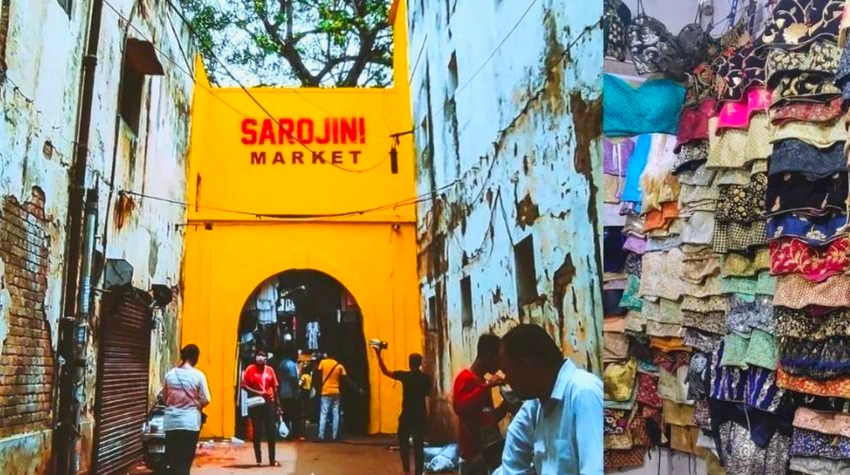
Is Sarojini Nagar Market Actually Thrift Shopping?
Is Sarojini Nagar Market Actually Thrift Shopping?
A closer look at Sarojini Nagar's ₹100 tops shows thrift myths crumble: most items are export surplus or factory rejects, not second-hand finds. What this means for sustainable fashion.
There is a particular fantasy attached to Sarojini Nagar: the idea that one is “thrifting.” That each ₹100 top is somehow analogous to a curated vintage find in a Brooklyn basement or a Depop archive page. But this fantasy begins to fracture the moment one asks a simple, slightly uncomfortable question; where do these clothes actually come from?
The popular myth oscillates wildly: from whispered claims of “dead people’s clothes” to the more Instagram-friendly narrative of sustainable fashion. The truth, however, is far less romantic and far more industrial.
Most clothing sold in Sarojini Nagar is not second-hand in the conventional sense but consists largely of export surplus and factory rejects, garments originally produced for global brands but discarded due to minor defects or overproduction.
This immediately complicates the label of “thrift.”
What Is Thrift Shopping, Anyway?
In its contemporary, globalised form, thrift shopping implies a few key things:
- Clothes that have been previously owned or used
- A system tied to reuse and sustainability
- Often a degree of curation or individuality
Sarojini only partially fits this definition.
Yes, there are second-hand garments circulating within Delhi’s informal clothing economy, often collected, sorted, and redistributed through long-standing systems of barter and resale. But these are only one stream among many. Much of what hangs on Sarojini racks is technically new, albeit rejected by global supply chains.
So if thrift implies reuse, Sarojini frequently offers something else: redistributed excess.
Export Surplus: Fast Fashion’s Afterlife
To understand Sarojini, one must look not at thrift culture, but at fast fashion logistics.
Factories producing for brands like Zara or H&M routinely sometimes overproduce by a small margin to account for quality control losses. The pieces that fail inspection (a loose thread, a slight dye variation) or remain unsold enter secondary markets at drastically reduced prices.
Sarojini Nagar is one such endpoint.
This positions the market less as a thrift ecosystem and more as a spillover zone of global capitalism a place where fashion’s excess is redistributed, not necessarily recycled.
The implication is subtle but important: buying from Sarojini is not always rescuing a garment from landfill; it may simply be participating in the afterlife of overproduction.
The Politics of Calling It “Thrift”
There is also a class dimension embedded in the language.
For decades, markets like Sarojini have served as primary retail spaces for working- and lower-middle-class consumers not as aesthetic playgrounds for conscious consumption. To call it “thrift” is, in some sense, to retrofit a Western, lifestyle-oriented vocabulary onto a space that historically functioned as necessity-driven commerce.
In other words, what is now branded as “thrifting” for some was always just shopping for others.
The Sustainability Question
At first glance, Sarojini appears aligned with sustainable fashion:
- Low prices discourage overvaluation of brands
- Clothes are reused or redistributed
- Waste is, in some sense, minimised
But the reality is less comforting.
The sheer affordability encourages overconsumption buying more because it is cheap, discarding more because it is replaceable. This mirrors, rather than resists, the logic of fast fashion.
Moreover, if much of the stock originates from overproduction, then Sarojini is not outside the fast fashion system, it is structurally dependent on it.
Even the second-hand flows within Delhi highlight that sustainability here is not a lifestyle choice but a labour-intensive survival system.
The Experience Economy of Sarojini
And yet, to reduce Sarojini to supply chains and semantics would be to miss its cultural force. With tens of thousands of daily visitors, the market is less a shopping destination and more a performative space of bargaining, discovery, and chaos.
The act of sifting through piles, negotiating prices, and finding something unexpectedly perfect creates a narrative of finding rather than simply buying. This is where Sarojini feels closest to thrift, not in origin, but in experience.
It produces the illusion of individuality within mass production.
So, Is It Thrift?
The answer, frustratingly, is: not quite but not entirely not.
Sarojini Nagar sits at an uneasy intersection of:
- Export surplus (new but rejected fashion)
- Informal second-hand economies
- Hyper-consumerist affordability
- Cultural performance of “finding a gem”
To call it thrift is to simplify a far more complex ecosystem. It is not a curated reuse market in the traditional sense, nor is it purely fast fashion retail. It is something messier: a hybrid economy shaped by global excess and local necessity.
The Romance vs The Reality
Perhaps the more interesting question is not whether Sarojini is thrift, but why we are so eager to call it that.
Because “thrifting” sounds ethical, intentional, even aesthetic. It allows the shopper to feel like a participant in sustainability, rather than in consumption.
Sarojini disrupts that comfort. It reminds us that behind every ₹100 top lies not just a good deal, but a chain of overproduction, labour, and redistribution that refuses to be neatly categorised.
And maybe that is precisely why it remains irresistible.
#SarojiniNagar #ThriftMyth #SustainableFashion #FashionTruth #BudgetFashion
