Pakistan Expert Parag Jain Takes Reins as RAW Chief

Pakistan Expert Parag Jain Takes Reins as RAW Chief
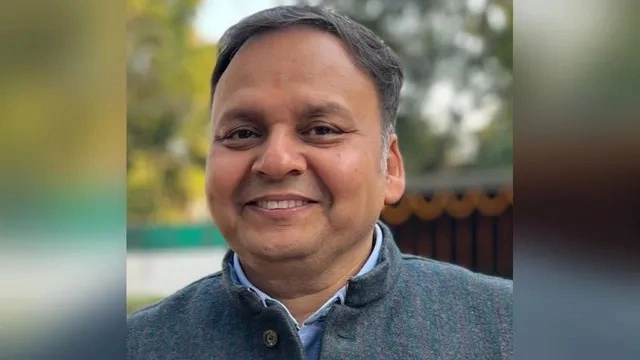
The Indian government has appointed Parag Jain as the new Secretary of the R&AW, effective July 1. Learn more about his background and what this means for national security.
On Saturday, the government issued an order designating Parag Jain, a 1989-batch Indian Police Service (IPS) officer from the Punjab Cadre, as the next Secretary of the Research and Analysis Wing (R&AW) for a two-year term. Ravi Sinha, a 1988-batch IPS officer of Chhattisgarh cadre, will step down as chief of the R&AW on June 30 and be replaced by Jain on July 1.
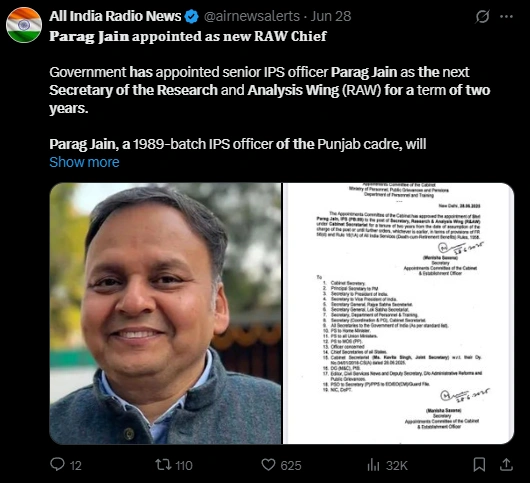
"The Appointments Committee of Cabinet has approved the appointment of Shri Parag Jain (PB:89) to the post of Secretary, Research & Analysis Wing (R$AW) under the Cabinet Secretariat for a tenure of two years from the date of assumption of the charge of the post or until further orders, whichever is earlier, in accordance with provisions of FR 56 (d) and Rule 16 (1A) of All India India Service (Death-cum-Retirement Benefits) Rule, 1958,"
The Department of Personnel & Training (DoPT) stated in an order. Jain is currently in charge of the Aviation Research Centre, which was instrumental in Operation Sindoor by gathering information about the Pakistani military and the precise locations of the terror camps in the neighboring nation.
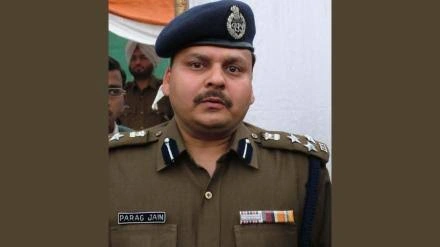
While serving as the Indian representative in the respective missions in Canada and Sri Lanka, the future R&AW chief has always been a quiet officer. After embracing the Khalistan ecosystem in Canada during his posting, he cautioned Delhi that it was turning into a threat. After Sinha is replaced by Jain on Monday, India's external intelligence agency will require a makeover because it has failed in the last two years during the crises in Bangladesh and the Maldives.
With Asim Munir now serving as a Field Marshal and cross-border terrorism against India at the top of the government's agenda, the role of the R&AW becomes crucial. Pakistan is expected to continue using terrorism as a cover for retaliation since India suspended the Indus Water Treaty; therefore, India's external intelligence must strengthen its ground operations instead of depending solely on technical assistance.
One way to interpret Jain's elevation is as a tactical realignment. He offers a well-rounded combination of technical know-how, diplomatic nuance, and fieldwork. India's external intelligence influence may return if it can strengthen surveillance networks, improve HUMINT operations, and combat hybrid threats. These objectives, however, depend on interagency collaboration and system agility. A strict bureaucracy could stifle audacious plans. The area is keeping a close eye on it.
#ParagJain #RAW #IndianPoliceService #NationalSecurity #GovernmentNews
