Olivia Rodrigo Just Built the Festival Pop Music Has Been Waiting For
Olivia Rodrigo Just Built the Festival Pop Music Has Been Waiting For
Olivia Rodrigo Just Built the Festival Pop Music Has Been Waiting For
The Daisy Chain Fields festival brought together pop legends and its newest stars. Rodrigo may have just created the next great tradition in women’s music.
Ten Hours, Two Stages and Absolutely No Reason to Sit Down
You know an inaugural festival has worked when you have spent more than ten hours in 95-degree heat, trudged between two stages every half hour and emerged from the experience thinking only one thing: when is the next one? That is exactly what netizens are saying right now.
This is the triumph of Olivia Rodrigo’s Daisy Chain Fields in Irvine, California. The heat was punishing and the humidity relentless, but the festival's 14-act bill somehow made the physical ordeal feel secondary. Across ten and a half hours, one performer followed another with very little dead space, creating a day that felt less like a conventional festival and more like an argument about where women in popular music have been—and where they are now going.
Rodrigo told the crowd that Daisy Chain Fields was not a one-off. Forty-five thousand people were already thinking about next year.
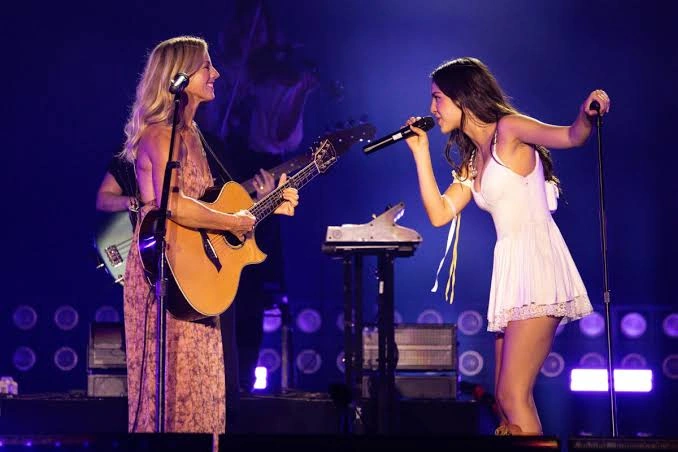
The most obvious ancestor of this jamboree is Lilith Fair, and Sarah McLachlan eventually appeared on Rodrigo's stage to give the connection a tangible form. They performed “Building a Mystery” and “Angel”, the latter dedicated to Dolly Parton. But Daisy Chain Fields did not feel like an attempt to recreate the 1990s. It felt like Rodrigo had taken the idea behind Lilith Fair and dropped it into a very different musical moment.
The Nineties Came Back and the Kids Already Knew the Words
If there was a secret heart to the festival, it was often found away from the main stage.
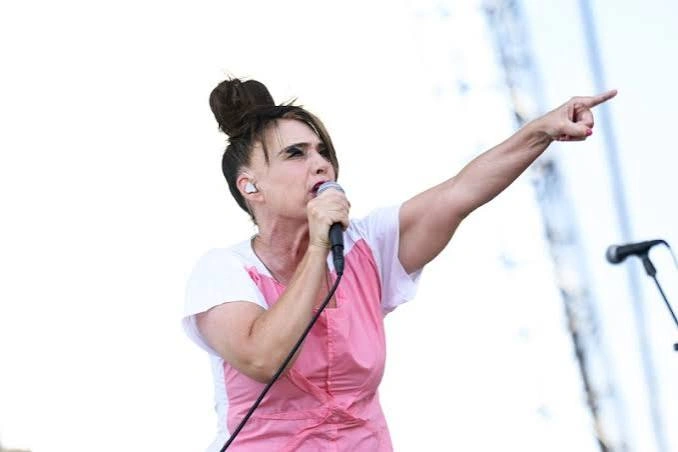
Bikini Kill played to a field of young women singing along to songs that belonged to a very different era. Kathleen Hanna reflected on playing Orange County in the 1990s, when only a handful of women might appear at a show, before bringing out three local women who had formed their own band after discovering Bikini Kill. Watching that exchange unfold at a festival attended by thousands felt like one of those rare moments when pop culture offers evidence of its own progress.
The Breeders kept the Nineties current on the Marigold Stage, while Garbage's Shirley Manson spoke about the band's engagement with LGBTQ+ themes before the language now used to describe them had become part of mainstream culture. The festival's younger audience did not treat these artists like museum pieces. That mattered.
There was a constant migration between the two stages, with twentysomethings and teenagers abandoning their positions near the main field to see the women who had shaped the music that came before them. Daisy Chain Fields became, for a few hours, a moving archive.
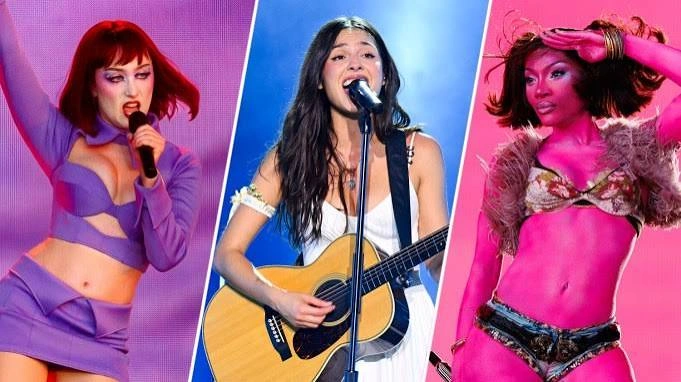
Chappell Roan Arrived in Purple
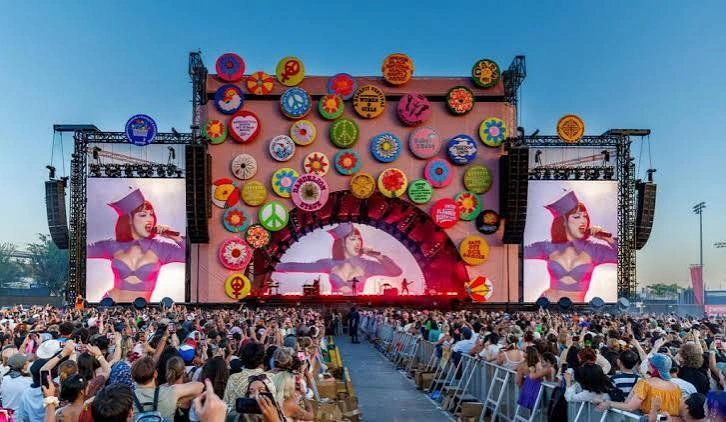
Then came Chappell Roan, who appeared in an entirely transformed purple look, resembling a fever dream of a 1960s TWA stewardess uniform. Her red hair remained, but the curls had disappeared into a shorter, straightened bob.
Roan performed for forty minutes with no surprises and no detours. “Only the hits today,” she told the audience. It worked. Her set suggested that reinvention does not always require a new song. A new silhouette, a different physicality and an artist visibly energised by the stage can make familiar material feel newly alive. She moved through her catalogue with an intensity that held the field completely.
Roan and Rodrigo performed back-to-back, and the pairing made the festival's wider proposition difficult to ignore. For one afternoon, it genuinely felt possible to believe that the 1990s and the 2020s have produced two of the most important generations of women in pop. History is rarely that neat. The atmosphere was persuasive enough to make the argument anyway.
Olivia Rodrigo's Coronation
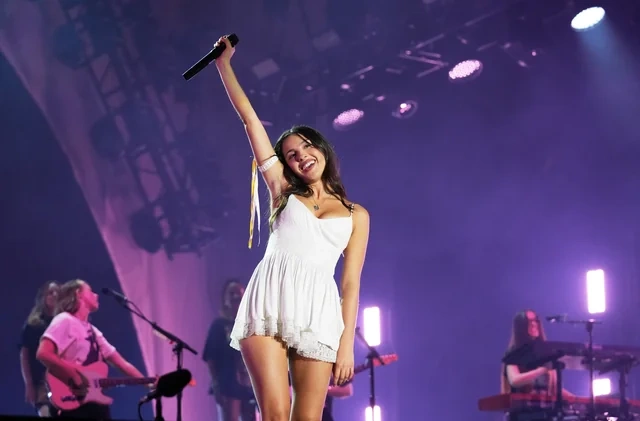
Rodrigo's closing set lasted an hour and twenty minutes, considerably longer than the other performances, and made room for some of the festival's most significant moments.
Alanis Morissette arrived as the day's genuine surprise for “Ironic”. Rodrigo's voice slipped easily into harmony with Morissette, just as it did with McLachlan and Stevie Nicks. She and Nicks closed the festival with “Landslide”, an ending that felt almost inevitable once the older artist had appeared.
Before Rodrigo's set, Melinda French Gates announced that she would match Rodrigo's previously announced $10 million donation to the festival's ten charity beneficiaries with another $10 million. It was a substantial gesture, but it also clarified that Daisy Chain Fields was designed to extend beyond its own stages.
Rodrigo herself seemed almost overwhelmed by the success of her first festival. Given the logistics, the scale and the weather, simply reaching the end without catastrophe probably deserved celebration. Instead, she had created a cultural event.
This Was Never Just an All-Women Festival
There have been other festivals with all-female or almost entirely female line-ups since Lilith Fair. But Daisy Chain Fields has something different working in its favour: Olivia Rodrigo.
A chart-topping artist can make the calls, attract the names and create the kind of instant sell-out that generates genuine FOMO. More importantly, Rodrigo brought together performers who would not normally appear within the same festival narrative. Mitski could be followed by Doechii. Bikini Kill could play to young fans. Stevie Nicks could close the evening alongside an artist from a completely different generation.
Daisy Chain Fields successfully demonstrated that an all-female line-up in 2026 does not need to justify itself as an experiment. Women already dominate popular music in ways that would have seemed more aspirational during the Lilith Fair era.
The festival was not asking whether women belonged at the centre of pop culture. Forty-five thousand people standing in a gridlocked car park after Stevie Nicks and Olivia Rodrigo sang “Landslide” already knew the answer.
The only question now is who Rodrigo calls for year two. I can't wait to find out!

Login to comment.
No thots yet. Be the first to share your thoughts!