Your AI Ear: The Privacy Cost of Always-On Intelligence?

Your AI Ear: The Privacy Cost of Always-On Intelligence?
Imagine an AI that listens 24/7 to offer real-time insights. Companies like Ambi are building it, but what are the hidden privacy costs of being 'always on'? This is the future of personal AI.
We're living in an era where the promise of AI hinges on its ability to understand us deeply. The more context it has, the more helpful it can be, or so the vision goes. This often means devices that listen, watch, or record continuously, gathering every possible piece of data about our lives.
Naturally, this vision brings significant privacy and data security concerns to the forefront.
Yet, startups are pushing forward, driven by the belief that the market for hyper-personalized assistance is vast enough to outweigh these ethical considerations.
One such company making waves is Ambi, co-founded by former Plaud executive Peter Mo.
They just secured $26 million across funding rounds, backed by Luminous Ventures and ODM Huaqin, to build an AI that aims to provide “real-time intelligence and insights” by listening to you all the time.
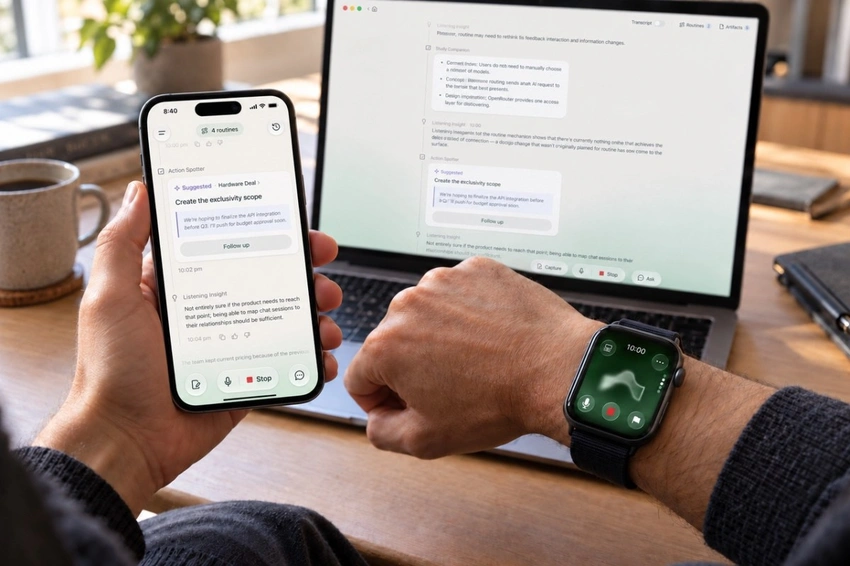
Ambi is launching apps for iPhones, Macs, and Apple Watch. Think of them as next-gen meeting notetakers, but with a crucial difference: users can opt to have them listening all day to capture context. While traditional notetakers summarize calls, Ambi wants its AI agent to start working during the meeting, leveraging your calendar, knowledge base, and web data to proactively offer suggestions or surface relevant information.
Mo envisions a future where intelligence isn't confined. He shared, 'The way we interact with intelligence is limited. Often the intelligence is trapped on the screen...
That's why we are building Ambi to use AI anytime and anywhere.' The company's ambitions are huge, with a forthcoming desktop app that will learn from your work and a planned hardware device featuring a screen, speaker, camera, and microphones for ultimate context capture and information display.
The Always-On Quandary: Privacy
This continuous capture brings us to the core ethical question: privacy. The concern isn't just about personal data, but also about the people around us. How do we ensure that Ambi's apps, or its future device, clearly indicate when conversations are being recorded to protect third parties?
Some meeting notetaker companies have faced lawsuits over recording conversations without explicit consent, and Apple's recent Audio Intelligence feature has also sparked privacy debates.
Ambi acknowledges these challenges.
Mo states that users can turn off ambient data capture at any time, and the feature is off by default .
The startup also claims it doesn't store user recordings and encrypts data, though the specific encryption method wasn't detailed.
However, the heavy lifting of disclosing ambient capture still falls on the user.
As Mo puts it, 'We, as an industry, haven't solved this problem [of disclosure].'
Are We Ready to Be Always Heard?
It's an industry-wide inflection point. The allure of an AI assistant that anticipates our needs and offers insights on the fly is powerful.
But the trade-off - a world where our words are constantly analyzed - forces us to consider the societal implications.
Are we prepared for a future where the line between private thoughts and public data blurs even further?
The conversation has only just begun.

Login to comment.