The Halo Effect: Why We Trust Pretty People Too Much

The Halo Effect: Why We Trust Pretty People Too Much
Explore the psychology of the halo effect and how physical attractiveness subconsciously warps our judgment, intelligence attribution, and daily decisions.
Picture this: You are walking down the street and spot a stranger holding a golden retriever. They are impeccably dressed, flash a dazzling smile, and drop their coffee cup with cinematic grace. Before they even speak a word, your brain has already checked several boxes.
You assume they are witty, financially stable, fiercely loyal, and probably great at hosting dinner parties.

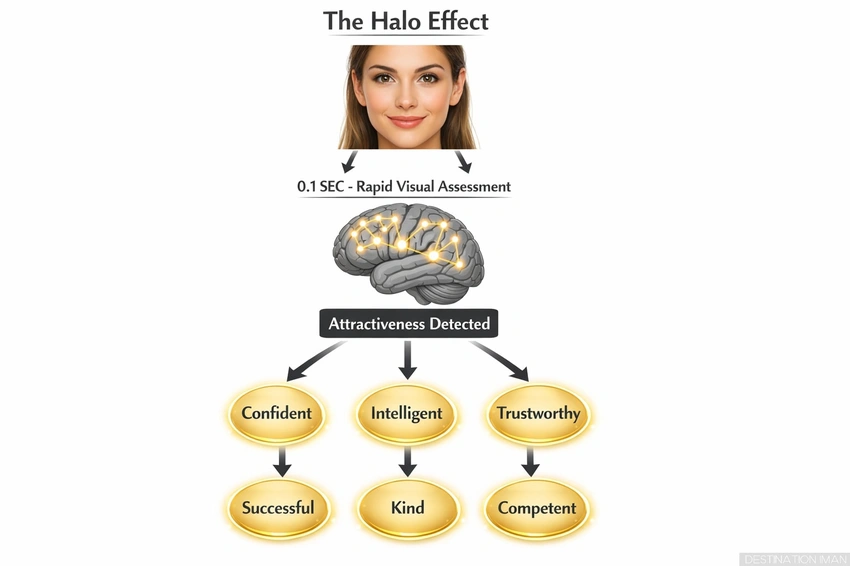
Welcome to the magic trick of the human brain known as the halo effect. Coined by psychologist Edward Thorndike in the 1920s, this cognitive bias occurs when our overall impression of a person influences how we feel and think about their specific traits. If someone has one shining positive quality, like being conventionally attractive, our brains automatically paint the rest of their personality with glowing, pastel colors.
We mistake good genes for a good soul, and it happens entirely beneath the surface of our conscious awareness.

Think about the last time you watched a court drama or read a news story about a sleek corporate scammer. Often, public commentary expresses shock because the defendant simply does not look the part. Daniel Kahneman explores similar mental shortcuts in his seminal book Thinking, Fast and Slow, reminding us just how much our brains love a shortcut.
When we evaluate someone, system one thinking takes the wheel.
It sees symmetry and clear skin, and it instantly concludes competence and trustworthiness.
We do not pause to collect data.
We let the aesthetic do the heavy lifting.

My friend Sarah once told me about her disastrous stint on a hiring committee. She caught herself grading a candidate with slightly lower qualifications much higher simply because he possessed the sharp jawline of a 1990s supermodel. When she realized what was happening, she felt a wave of secondhand embarrassment.
We all do it. Studies show that attractive individuals are more likely to get hired, receive lighter criminal sentences, and even win political elections.
Beauty acts as a social fast pass, whisking people past the line of rigorous scrutiny.

So, how do we break the spell of the halo effect when our brains are literally hardwired to admire symmetry? The trick is slowing down our decision-making process and introducing friction into our first impressions. When you find yourself instantly charmed by someone, ask yourself a simple question: What actual evidence do I have for this assessment?
Acknowledging our biases does not make us bad people, it just makes us self-aware humans navigating a visually obsessed world.

Login to comment.