Moon Dust: The Ultimate Cosmic Archive for Alien Tech?

Moon Dust: The Ultimate Cosmic Archive for Alien Tech?
Forget radio signals! A groundbreaking idea suggests alien technology might be hidden in moon dust. Could ancient 'technograins' tell us stories of long-gone civilizations? Dive into this cosmic mystery!
For decades, humanity has scanned the cosmos for signs of intelligent life, listening intently for radio signals or laser transmissions. But what if we’ve been looking in the wrong direction, or rather, for the wrong kind of evidence? A fascinating new proposition suggests that traces of alien technology might not be beaming across light-years, but rather lying dormant, just a quarter-million miles away, embedded in the very dust of our Moon.
The Problem with Active Signals
The traditional "active signal" approach has a significant hurdle. Imagine two civilizations, separated by vast cosmic distances. For them to detect each other, they would need to exist simultaneously and be actively broadcasting detectable signals for a prolonged period. Earth itself illustrates this challenge: we’ve only been sending strong radio signals into space for about a century. With newer, more efficient communication tech, our broadcast leakage is already diminishing. The chances of this fleeting window overlapping with another civilization's similar broadcast might be incredibly slim. It’s like trying to catch two lightning bugs flashing at the exact same millisecond in a universe-sized forest.
Enter Passive Technosignatures
This is where the new idea shines. Instead of seeking active chatter from a vibrant, broadcasting civilization, what if we looked for "passive technosignatures"? These are physical remnants, like cosmic archaeological artifacts, that could endure long after their creators have vanished. Think colossal engineering projects – structures designed to harness starlight, like massive mirrors or components of Dyson swarms. Even if these grand structures eventually crumbled, shattered by collisions or orbital decay over eons, their essence might persist.
The Moon's Role as a Cosmic Archive
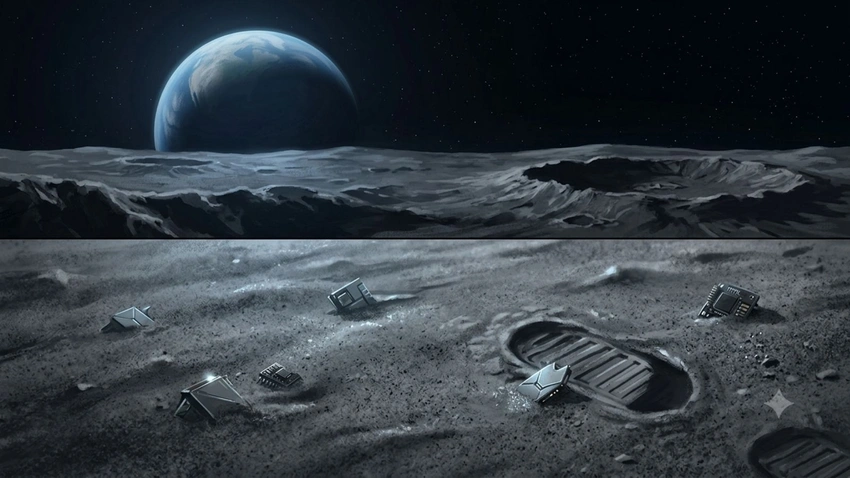
And this is where our Moon becomes the ultimate suspect. Imagine these ancient, gigantic alien artifacts slowly breaking down into microscopic particles over billions of years. We could call these "technograins" – tiny, engineered dust motes, perhaps too small for us to easily recognize without advanced techniques, yet fundamentally non-natural. The Moon, lacking a thick atmosphere or significant geological activity, is a pristine, frozen museum. Unlike Earth, where erosion, weather, and tectonics constantly recycle and erase historical evidence, the lunar surface is an unparalleled archive. These technograins, scattered by cosmic winds or deposited through ancient impacts, could be preserved in the regolith, waiting for us to scoop them up.
A New Frontier for Exploration
The implications are staggering. Our future lunar missions wouldn't just be about geology or resources; they could become unprecedented archaeological digs. Analyzing moon dust for anomalous atomic structures, unusual isotopic ratios, or even microscopic patterns that defy natural explanation could open an entirely new chapter in the search for extraterrestrial intelligence. It shifts the paradigm from listening for whispers in the dark to sifting through ancient cosmic debris for tangible proof. Perhaps the greatest secret of the universe isn't hidden in a distant galaxy, but right under our cosmic nose, buried in the lunar soil. It’s a mind-bending thought, one that could redefine humanity’s place in the cosmos.
