Why More Smart Homes Are Using ZigBee IR Blasters

Why More Smart Homes Are Using ZigBee IR Blasters
Control existing split AC systems with ZigBee IR blasters for smart HVAC automation, energy efficiency, and building integration.
As buildings become smarter, many facility owners face a common challenge: how to integrate existing split air conditioners into modern automation systems without replacing perfectly functional equipment.
Since most split air conditioners are still controlled by infrared (IR) remote controls, they cannot communicate directly with smart building platforms. This is where a ZigBee IR blaster 🔗 becomes valuable.
Instead of replacing the air conditioner itself, a ZigBee IR blaster bridges the gap between a ZigBee automation network and traditional IR-controlled HVAC equipment, making centralized and remote control possible.
Whether you’re a system integrator, hotel operator, HVAC contractor, or IoT solution provider, understanding how this technology works can help you build more flexible and cost-effective smart HVAC systems.
What Is a ZigBee IR Blaster?
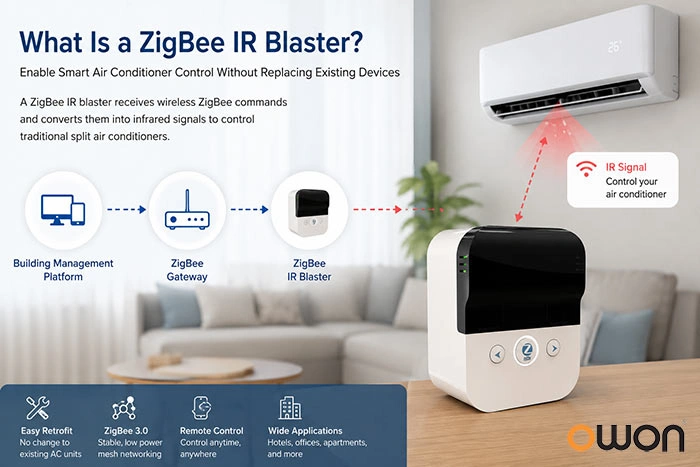
A ZigBee IR blaster is a device that receives wireless ZigBee commands and converts them into infrared signals that existing split air conditioners can understand.
Rather than communicating directly with the HVAC equipment, the controller emulates the original handheld remote control, allowing the air conditioner to respond exactly as it would to normal user operation.
Because no modifications are required to the air conditioner itself, ZigBee IR blasters are widely used in retrofit projects where replacing HVAC equipment would be expensive or impractical.
Many commercial users also refer to this type of device as a ZigBee AC controller 🔗, since it enables centralized management of multiple air conditioners through a ZigBee network.

Why Choose ZigBee for Air Conditioner Control?
Several wireless technologies can be used for HVAC automation, including Wi-Fi, Bluetooth, and proprietary RF solutions. However, ZigBee remains one of the most widely adopted protocols for commercial building automation.
Its advantages include:
- Low power consumption
- Reliable mesh networking
- Stable communication across large buildings
- Support for hundreds of connected devices
- Proven interoperability in smart building ecosystems
These characteristics make ZigBee particularly suitable for hotels, apartment buildings, offices, schools, and light commercial facilities where multiple air conditioners need centralized management.
How Does ZigBee Air Conditioner Control Work?
A typical system includes four key components:
Building Management Platform → ZigBee Gateway → ZigBee IR Blaster → Split Air Conditioner
The automation platform sends commands through the ZigBee gateway.
The ZigBee IR blaster receives those commands and converts them into infrared signals, which are then transmitted to the indoor air conditioner just like a traditional remote control.
This architecture allows existing split air conditioners to become part of a modern smart HVAC system without replacing the original equipment.
Where Are ZigBee IR Blasters Commonly Used?
Although ZigBee IR blasters are suitable for residential automation, their greatest value is often found in commercial HVAC projects.
Typical applications include:
- Hotels and serviced apartments
- Office buildings
- Student accommodation
- Retail stores
- Healthcare facilities
- Educational campuses
- Smart residential communities
In these environments, centralized HVAC control helps improve operational efficiency while reducing unnecessary energy consumption caused by forgotten or improperly configured air conditioners.
What Should Buyers Look for?
Choosing the right ZigBee IR blaster involves more than simply checking compatibility with an air conditioner brand.
For professional deployments, buyers should consider:
- Stable ZigBee communication
- Extensive built-in IR code library
- IR learning capability for unsupported brands
- Reliable infrared transmission
- OTA firmware upgrade support
- Local API or cloud integration options
- Flexible installation methods
- OEM and ODM customization capability
System integrators should also evaluate whether the manufacturer can provide long-term technical support and firmware maintenance throughout the project lifecycle.
Choosing the Right Solution for Different HVAC Projects
Not every installation has the same requirements.
For standard split air conditioner retrofit projects, a basic ZigBee IR controller is often sufficient.
More advanced commercial projects may require additional capabilities such as:
- Energy consumption monitoring
- Temperature and humidity sensing
- Concealed installation above suspended ceilings
- External IR emitters
- Remote temperature probes
Selecting the appropriate controller based on the installation environment helps simplify deployment and improve long-term system performance.
Why the Right Manufacturing Partner Matters
For distributors, OEM brands, and system integrators, choosing the right hardware supplier is just as important as choosing the right technology.
A professional manufacturer can offer:
- Stable product supply
- Long product life cycles
- Firmware customization
- Private branding (OEM)
- Hardware customization (ODM)
- Integration APIs
- Technical support for commercial deployments
These capabilities reduce project risk while making it easier to scale smart HVAC solutions across multiple buildings.
Conclusion
A ZigBee IR blaster offers a practical way to connect traditional split air conditioners to modern building automation systems without replacing existing HVAC equipment.
By combining ZigBee networking with infrared control, organizations can improve operational efficiency, simplify centralized management, and reduce retrofit costs.
For example, manufacturers such as OWON Technology provide a range of ZigBee HVAC control solutions designed for different commercial scenarios—from standard split air conditioner control to models supporting energy monitoring or concealed ceiling installations. Backed by years of experience in IoT, HVAC control, and OEM/ODM manufacturing, OWON works with system integrators, HVAC equipment manufacturers, and smart building solution providers worldwide to develop reliable wireless HVAC solutions.
If you’re evaluating a ZigBee IR blaster for your next HVAC automation project, consider working with an experienced OEM partner that can provide not only reliable hardware but also long-term technical support, customization services, and integration expertise.
ZigBee IR BlasterZigBee AC ControllerZigBee Air Conditioner ControllerSmart AC ControllerZigBee HVAC ControlSmart HVAC AutomationHVAC Retrofit SolutionWireless AC ControllerSmart Building HVAC System

Login to comment.
No thots yet. Be the first to share your thoughts!