Six planets light up the night sky in a rare celestial parade

Six planets light up the night sky in a rare celestial parade
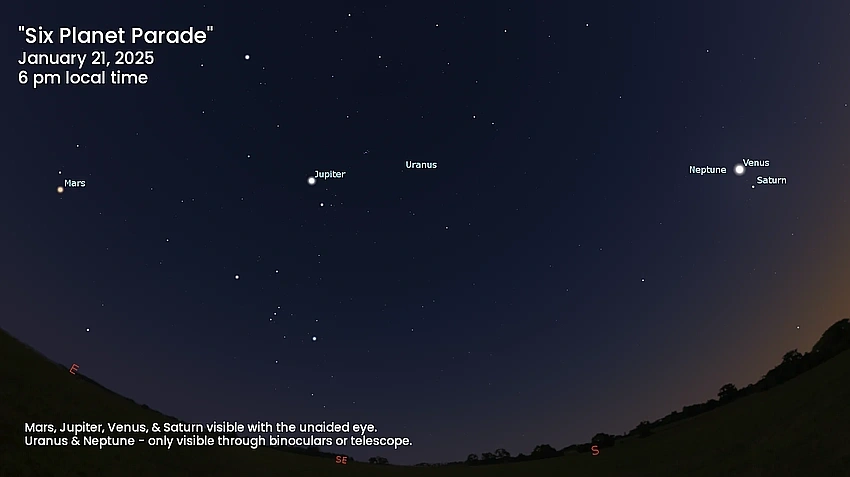
Six planets—Jupiter, Saturn, Venus, Mercury, Neptune and Uranus—will form a curved line across the evening sky for a few days, with binoculars needed for the outer two.
A rare celestial parade will let skywatchers glimpse Jupiter, Saturn, Venus, Mercury, Neptune and Uranus all at once, forming a curved arc across the western sky. For the next few days, the six planets will be visible simultaneously, though Neptune and Uranus require binoculars or a small telescope to pick out. In celebration of the event, NASA released new sonifications—astronomical data from its Chandra X-ray Observatory translated into sound—for Jupiter, Saturn and Uranus. Dr Megan Argo, a reader in astrophysics, said the sight is a rare phenomenon. “We’re seeing this alignment now because the planets’ orbits have brought them into roughly the same area of the sky from our perspective on Earth. Since each planet circles the sun at a different speed, they constantly shift position against the backdrop of stars. Only occasionally do their paths line up in a way that places several of them together in our night sky,” she said. “While it’s fairly common to spot four or five planets at the same time, seeing six is much rarer. All seven were visible together last year, but the next full line up won’t occur again until 2040.”
