SC Seeks ECI Reply on SIR Pleas Across TN, WB, Kerala

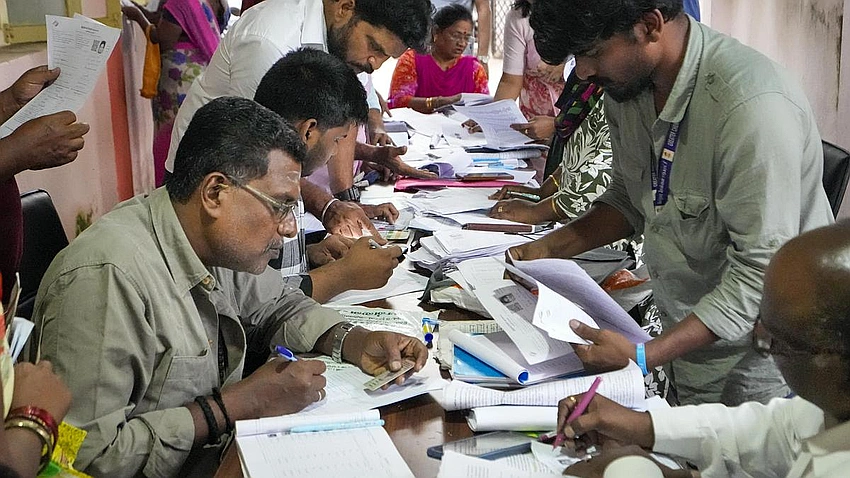
SC Seeks ECI Reply on SIR Pleas Across TN, WB, Kerala
The Supreme Court presses the ECI for replies on pleas challenging the Special Intensive Revision in Tamil Nadu, West Bengal, and Kerala, stressing the need to weed out dead voters.
The Supreme Court on Wednesday stressed that weeding out dead voters from electoral rolls is essential to deny any undue advantage to political parties, as petitions challenge the Election Commission’s Special Intensive Revision (SIR) being carried out in multiple states. A bench led by the Chief Justice of India, along with Justice Joymalya Bagchi, noted the broader principle that post-independence revision exercises must be conducted fairly and without exclusion. The court’s remarks come as the ECI accuses some political parties and leaders of manufacturing a scare around the SIR process.
The petitions, which challenge the SIR in Bihar and in Tamil Nadu, West Bengal and Kerala where the process is underway, have prompted the bench to scrutinize the conduct and scope of the revision. The judges highlighted concerns about how the enumeration forms are processed and questioned whether officers are effectively distinguishing between citizens and non-citizens. The court indicated that such determinations should fall to a quasi-judicial tribunal, not an ECI officer, underscoring the need for due process and fairness in updating rolls.
As the enumeration in Tamil Nadu, West Bengal and Kerala proceeds, the court was informed that the ongoing SIR will be completed on December 4 in those states. The discussion also touched on the argument from senior advocate Kapil Sibal, appearing for some petitioners, that while the ECI clearly has the power to conduct SIR, the procedure must be reasonable and non-exclusionary. He stressed that any removal of voters must follow a fair process to avoid excluding eligible citizens.
The bench underscored that, despite the ECI’s authority, there are legitimate concerns about voter disenfranchisement and the political implications of broad deletions. In Bihar, the court noted, about 366,000 voters who did not appeal against their deletion illustrate how revision activities can affect the rolls substantially. The judges directed the Election Commission to file its response to the pleas challenging SIR in Tamil Nadu by December 1, a timeline that signals the proceeding’s importance to the broader electoral framework.
The hearing signals a pivotal moment for electoral integrity in the country, with the court seeking a balance between cleaning up rolls and preserving the rights of voters, while keeping political considerations in check. The ongoing debates around SIR reflect broader tensions between legitimate electoral maintenance and concerns about exclusionary practices that could alter the outcome of elections.
Cover image source: Supreme Court hearing on SIR LIVE: SC to continue to hear pleas today 🔗
