Why Everyone Wants to Prove They Can Handle Buldak

Why Everyone Wants to Prove They Can Handle Buldak
Why Everyone Wants to Prove They Can Handle Buldak
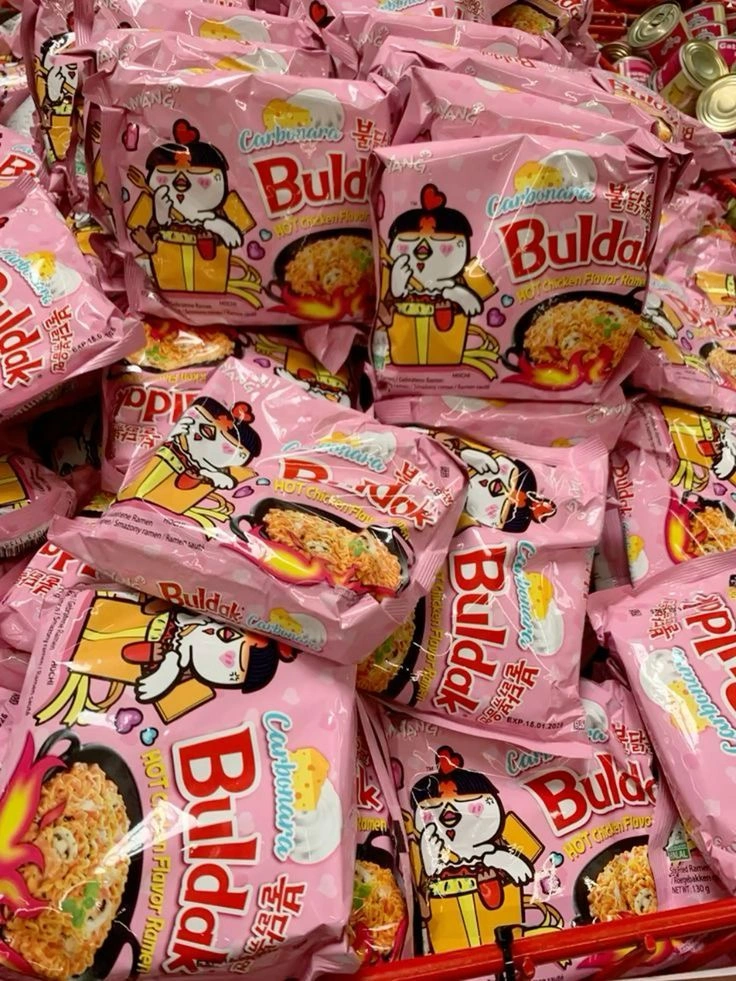
Scroll through TikTok for five minutes and you’ll see it: red packets, glossy black noodles, streaming tears, forced laughs, captions that read “it’s not even that spicy” while someone’s stomach is clearly preparing a revolt.
Buldak noodles aren’t just food anymore. They’re a test. A flex. A public demonstration of how much discomfort you can endure without breaking character. And if you think this is just about spice tolerance, it’s not.
This obsession says something deeper about Gen Z: about pain, performance, and the way toughness has quietly mutated online.
Once upon a time, spicy food was cultural, contextual, and communal. You ate it because it tasted good, because it was familiar, because it was part of where you came from. Now? You eat it for an audience.
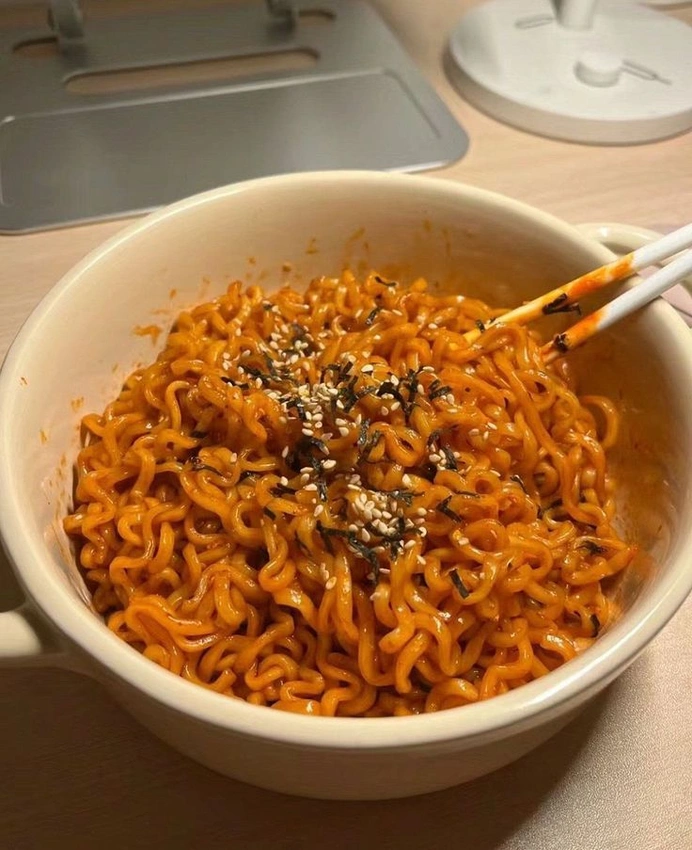
Buldak challenges thrive in a content ecosystem that rewards extremes. The louder the pain, the more impressive the endurance. Watching someone struggle becomes entertainment. Suffering becomes proof.
If you cry but keep eating, you’re strong. If you tap out, you’re weak.
Gen Z talks openly about mental health, burnout, and softness — which is real progress. But alongside that openness sits a strange contradiction: a renewed obsession with toughness.
Not the obvious, aggressive kind, but the quiet, ironic, “I can take it” kind.
Eating ultra-spicy noodles fits perfectly into this narrative:
- You suffer, but you joke.
- You’re uncomfortable, but you don’t complain.
- You post proof that you can endure.
It’s toughness disguised as humor and relatability.
This is toxic toughness, not because eating spicy food is bad, but because pain is framed as something you owe the internet: something you must withstand to be taken seriously.
There’s a fantasy baked into these challenges: the idea that enduring small, visible pain proves resilience. As if eating Buldak without crying means:
- you’re emotionally strong,
- you’re mentally tough,
- you’re not fragile,
- you’re worthy of respect.
This logic makes sense in a generation that feels constantly overwhelmed. When life feels uncontrollable: unstable economies, academic pressure, climate anxiety, controlling pain feels grounding.
You can’t fix everything. But you can finish the bowl. The noodles become symbolic: if you survive this, maybe you’re surviving life too. Spice tolerance has long been tied to masculinity. Being able to handle heat signals dominance, control, toughness.
But what’s interesting is how this has shifted across genders.
Men eat Buldak to prove they’re unbothered. Women eat Buldak to prove they’re not delicate. Everyone eats Buldak to prove they’re not soft. Even in a culture that claims to value gentleness, softness still feels like something you have to defend yourself against.
The spice challenge becomes a way to say:
I’m strong enough to suffer and still smile.
Here’s the quiet problem: the body doesn’t care about trends. Capsaicin irritates the stomach lining. Repeated exposure can worsen acid reflux, gastritis, IBS, and gut inflammation. But digestive discomfort is often treated as a punchline.
“Worth it.” “My stomach hates me.” “I’ll regret this later lol.”
Pain becomes delayed, and therefore ignorable.
Gen Z is uniquely skilled at intellectualizing discomfort while remaining emotionally disconnected from the physical consequences. We normalize after-the-fact suffering as a tradeoff for the social moment. Quitting mid-bowl carries social meaning. Stopping means:
- you couldn’t handle it
- you gave up
- you weren’t tough enough
Even if your body was begging you to stop. This logic mirrors deeper cultural training: push through, don’t be dramatic, don’t inconvenience others with your limits. The same pattern shows up in work culture, academia, relationships: Buldak just makes it visible.
Despite all the talk about softness, wellness, and self-care, many Gen Zers still feel the need to prove they’re not weak.
Buldak becomes a low-stakes way to demonstrate resilience without vulnerability. You don’t have to talk about your fears: just eat the noodles.
It’s safer to show physical endurance than emotional honesty. Spice becomes a substitute language for strength. There’s nothing wrong with enjoying spicy food. There’s nothing wrong with internet trends. The problem starts when pain becomes mandatory for belonging.
True strength doesn’t look like ignoring your body. It looks like listening to it. Choosing not to prove toughness, especially online, is quietly radical. Stopping mid-bowl isn’t weakness. It’s self-trust.
Your body isn’t a stage. Your discomfort doesn’t owe anyone content. And you don’t need to finish the bowl to prove you’re strong enough.
Sometimes, the strongest thing you can do is put the fork down.
