Why Are Novels Now Written Like We Are Stupid?


Why Are Novels Now Written Like We Are Stupid?
Why Are Novels Now Written Like We Are Stupid?
New studies show fiction is growing more readable, with shorter sentences and closer-to-speech prose. This piece weighs whether simpler prose trims nuance or spark, challenging readers to notice trade-offs.
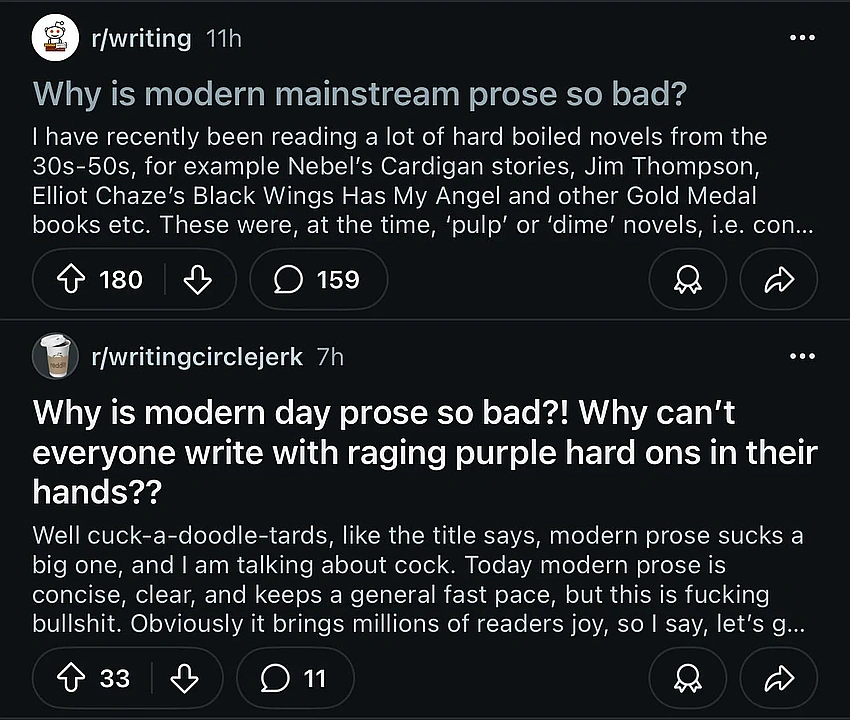
There is a particular irritation that has become increasingly difficult to ignore: the sense that contemporary novels no longer trust their readers. Everything is spelled out. Emotions are named before they are felt. Subtext is replaced with text. You do not infer; you are told.
This frustration is not new, but it has recently been sharpened by online discourse. The claim is provocative: novels are being written as if readers cannot handle ambiguity, complexity, or even patience.
But irritation is not evidence. So the question remains; has something actually changed?
The Measurable Simplification of Fiction
Some evidence suggests that the answer is, at least partially, yes.
Studies in computational literary analysis indicate that novels have, over time, become more “readable” in a technical sense. Sentence lengths have shortened, and prose has moved closer to spoken language patterns. Other large-scale analyses of English-language fiction similarly show a steady rise in readability scores across decades.
This does not necessarily mean that novels are intellectually simpler. But it does indicate a stylistic shift: towards clarity, brevity, and immediacy.
There are structural reasons for this. Dialogue-heavy narratives, for instance, tend to use shorter, more direct sentences. As contemporary fiction increasingly mimics conversational rhythm, it also becomes easier to process. That ease, however, can feel like dilution.
The key distinction here is subtle but important: accessibility is not the same as simplification. Yet the two often blur.

The Reader Has Changed Too
Blaming writers alone would be convenient and wrong.
Reading habits themselves have undergone a significant transformation. Data shows that reading for pleasure has declined sharply over the past two decades, with some studies estimating a drop of over 40% in daily reading time. Even among those who do read, sustained attention has weakened, particularly among younger demographics.
This is not merely about laziness or distraction. It is about environment. Digital media has restructured attention spans, privileging speed, fragmentation, and constant stimulation. In such a landscape, the slow demands of literary fiction begin to feel almost adversarial.
The concept of aliteracy, or, the ability to read without the desire to do so, becomes relevant here. It describes a cultural condition in which reading is no longer a default leisure activity, even among the literate.
If readers are changing, it follows that writing will adapt.
Writing Down, or Writing Across?
To say that novels are being “dumbed down” is tempting, but it risks oversimplifying the situation in precisely the way it critiques.
Historically, literature has always negotiated with its audience. Even readability research shows that most popular texts are written below the reader’s maximum capacity, not at it. People read more comfortably when language is slightly easier than their full ability.
In that sense, contemporary fiction may not be writing down to readers but across to them, adjusting to their habits, their time constraints, their cognitive rhythms.
The problem arises when this adjustment becomes over correction. When clarity turns into redundancy. When emotional cues are over-explained. When narrative assumes not just limited time, but limited intelligence.
That is the moment where readers begin to feel insulted.
The Persistence of Complexity
And yet, it would be dishonest to claim that complexity has disappeared.
Difficult, layered, and stylistically ambitious novels continue to be written and read. What has changed is their position within the cultural ecosystem. They are no longer the default centre but one option among many.

Genres like young adult fiction, for example, deliberately prioritise accessibility while still engaging with serious themes. Meanwhile, experimental and literary fiction often exist in smaller, more specialised readerships.
The literary field has not flattened; it has fragmented.
Which means that the frustration may not be about the disappearance of complexity, but about its reduced visibility.
So, Are We Stupid?
The uncomfortable answer is: not exactly but not entirely blameless either.
Readers today are not less intelligent. But they are differently trained. The cognitive habits required for deep reading such as patience, inference, tolerance for ambiguity are no longer as widely practised.
Writing reflects this. It anticipates distraction. It compensates for it.
In that sense, novels are not written as if we are stupid. They are written as if we are tired, busy, and easily pulled away.
Which, more often than not, is true.
What This Means for Reading Now
The real question is not whether novels have changed, but what we want from them.
If literature is reduced to pure consumption, then it will continue to simplify. If, however, readers demand difficulty, opacity, and interpretive labour, then writing will respond accordingly.
The relationship is reciprocal.
So perhaps the irritation is useful. It signals a desire for more for texts that resist, that withhold, that trust.
And those texts still exist. The difficulty lies not in their absence, but in choosing them, and staying with them long enough for them to unfold.
#Literature #Readability #Fiction #BookCulture #NovelAnalysis
