UK Christian Nationalists: Heritage Over Faith? Report Uncovers Surprising Truth
UK Christian Nationalists: Heritage Over Faith? Report Uncovers Surprising Truth
A new report reveals that Christian nationalism in Britain is largely driven by individuals who rarely attend church, prioritizing 'Christian heritage' over active religious practice. Discover the findings on identity, i
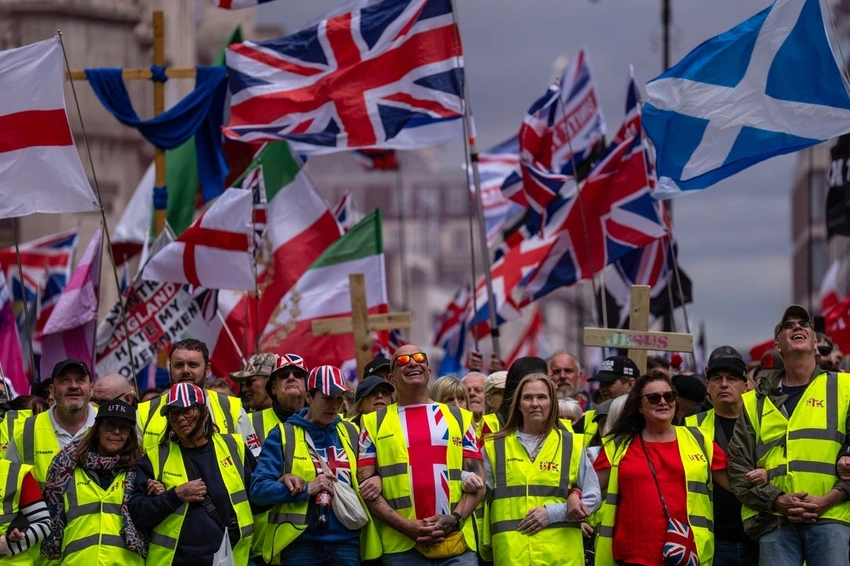
A new report suggests that Christian nationalism in Britain is primarily fueled by individuals who seldom participate in church services, yet are deeply committed to safeguarding the country's perceived Christian heritage. This intriguing finding challenges the notion that the increasing prominence of Christian symbols and slogans, like those seen at recent 'Unite the Kingdom' rallies where crosses were carried and 'Christ is King' chanted, signifies a genuine religious revival.
The research, conducted by the thinktank Theos, surveyed 1,765 adults in April 2026 to understand their attitudes towards Christianity and Britishness. It identified five distinct groups, with the 'identity integrationists' representing those whose views most closely align with Christian nationalism. This group, comprising 11% of respondents, is the smallest but holds significant views.
While 81% of 'identity integrationists' identify as Christian, a mere 13% attend church weekly, only slightly above the 11% national average.
Less than a third (31%) pray weekly, and fewer than half (47%) express interest in the Bible.
Strikingly, this group exhibits strong hostility towards immigration and Islam.
Only 19% believe Christian values mandate welcoming asylum seekers, and just 30% support the equal treatment of all religions in public life. A dominant belief among them (90%) is that defending Britain's Christian culture and heritage is crucial to being Christian.
In stark contrast, another group, termed 'belief integrationists,' also showed high levels of Christian affiliation but were considerably more religiously observant and less antagonistic towards immigration and religious diversity. This group accounted for 13% of respondents; 31% attended church weekly, 46% prayed weekly, and 62% were interested in the Bible.
Nearly half (48%) agreed that Christian values call for supporting asylum seekers, and 63% advocated for the equal treatment of religions.
Crucially, only 18% of these more religiously active 'belief integrationists' felt that defending Britain's Christian culture and heritage was essential to their faith, highlighting a significant divergence from the 'identity integrationists.' The report concludes that Christianity is increasingly being invoked as a marker of British identity amidst broader concerns about immigration, Islam, and cultural shifts, rather than reflecting a burgeoning religious commitment.
The survey also revealed wider societal anxieties: 55% of Britons would be unhappy if their local church were converted into a mosque, with 37% expressing strong disapproval. Additionally, over a third (37%) endorsed the 'great replacement' theory, a conspiracy suggesting a deliberate replacement of Europe's white population by Muslim migrants.
Nick Spencer, a senior fellow at Theos and one of the report's authors, suggested that differences in religious practice and ethnic composition might partly explain the differing attitudes towards asylum seekers between the two groups, noting that the more observant Christian group was also more ethnically diverse.
#ChristianNationalismUK #UKIdentity #TheosReport #UniteTheKingdom
