Interpol’s This Mirror Weighs a Ton: The Weight of Becoming Someone Else

Interpol’s This Mirror Weighs a Ton: The Weight of Becoming Someone Else
Interpol’s This Mirror Weighs a Ton: The Weight of Becoming Someone Else
Interpol’s eighth album, This Mirror Weighs a Ton, looks beyond early-2000s nostalgia, turning memory, alienation and modern loneliness into a striking new chapter.
There is something strangely appropriate about Interpol returning in 2026 with an album called This Mirror Weighs a Ton. For a band whose music has always been preoccupied with cities, alienation, memory and the peculiar loneliness of modern life, the mirror becomes more than an object of self-recognition. It becomes an archive. What we see in it is everything we have accumulated.
Released on 28 August through Partisan Records, This Mirror Weighs a Ton is Interpol’s eighth album and arrives at an interesting point in the band’s cultural life. More than two decades after Turn on the Bright Lights, Interpol are no longer simply a band being rediscovered by listeners nostalgic for early-2000s indie. They have become part of the vocabulary of contemporary alternative culture itself. Their new album is therefore less concerned with returning to the past than with asking what remains when the past becomes impossible to escape.
The Mirror as Metaphor
The album’s central metaphor is unusually revealing. A mirror traditionally promises clarity, but Interpol make recognition feel oppressive. The self is not necessarily liberating when it is finally confronted. It carries history, contradiction and responsibility.
This is particularly apparent in the title track, where the band's traditionally guitar-led architecture gives way to distorted bass, atmospheric percussion and an almost trip-hop-like spaciousness. Rather than sounding like a nostalgic reconstruction of Interpol’s earlier work, the song suggests a band deliberately making room for unfamiliar textures. The result is introspective without becoming static.
That movement between familiarity and estrangement becomes one of the album's most compelling qualities. See Out Loud restores the driving post-punk momentum associated with classic Interpol, while Iron City turns towards the anxieties of artificial intelligence and technological alienation. The city, one of Interpol's oldest imaginative landscapes, is consequently no longer merely a physical environment. It becomes an increasingly digital and psychological space.

New York, Revisited
There is also something almost literary about the album's relationship with New York. Interpol recorded the record in the city for the first time in more than a decade, and that return seems to matter. New York has always been inseparable from the mythology surrounding Interpol, but here it functions less as a nostalgic backdrop than as a place carrying its own weight.
The band's circumstances have changed too. Producer Andrew Wyatt brings a broader sonic vocabulary to the record, while bassist Brad Truax contributed basslines to the album. The expanded line-up and the return to recording in New York are important factors in the record's renewed sense of energy.
That sense of renewal is audible. Wings On Fire pushes towards something larger and more physical, while So Rides The Reindeer introduces acoustic guitar and a noticeably different rhythmic character. Wake Up moves further into funk and danceable territory. These experiments do not erase the Interpol aesthetic. Instead, they stretch it.

The Anxiety of Now
Perhaps the most interesting development is the album's engagement with contemporary anxieties. Iron City approaches artificial intelligence, while Wounded Soldier considers the psychological effects of encountering violence through media. Interpol's old fascination with alienation therefore acquires a new political and technological dimension.
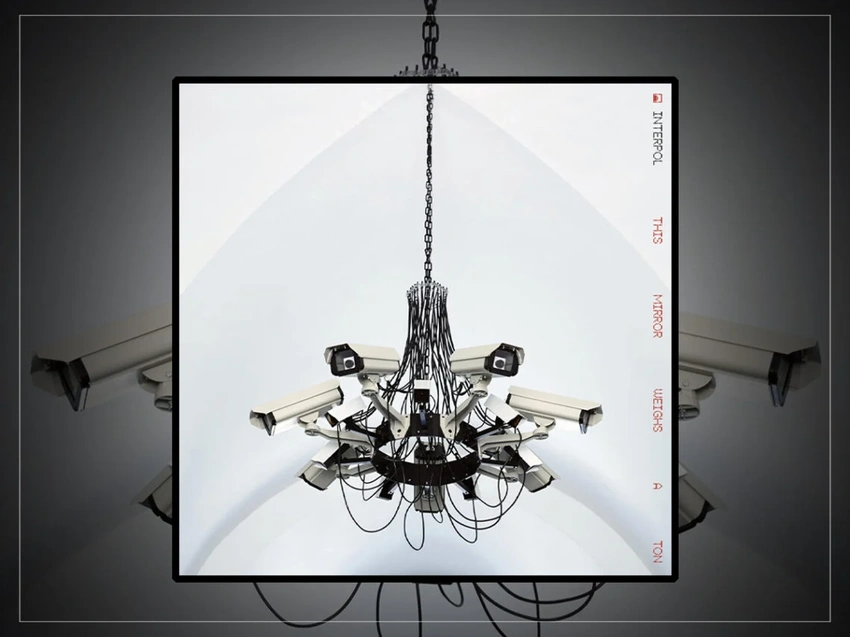
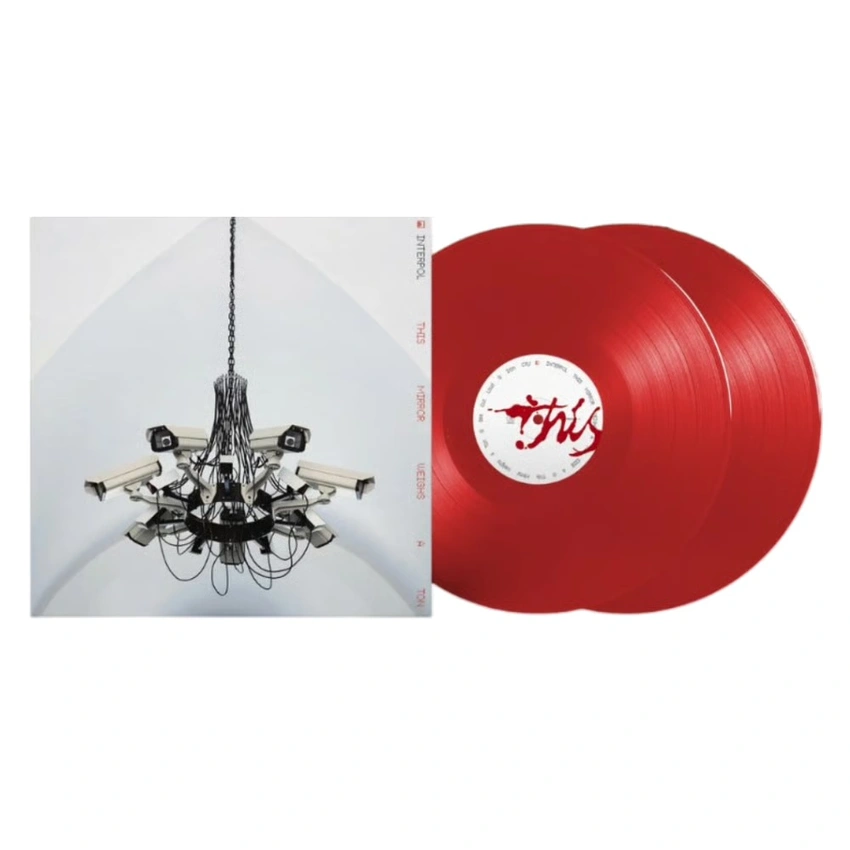
This matters because alienation in 2026 looks different from alienation in 2002. The early Interpol character could disappear into the anonymity of the city. Now the problem is almost the opposite: we are constantly visible, recorded, measured and translated into data. The cover's imagery of surveillance cameras reinforces this atmosphere, turning observation into part of the album's visual and conceptual language.
Yet This Mirror Weighs a Ton does not become a technological dystopia album. Its concerns remain fundamentally human. The record repeatedly returns to uncertainty, identity and the difficulty of understanding oneself. Even its strangest musical experiments ultimately lead back to the question of what it means to remain a person in a world that keeps changing around you.

Interpol, After the Past
The temptation with a band like Interpol is always to measure every new release against Turn on the Bright Lights or Antics. This Mirror Weighs a Ton seems deliberately resistant to that comparison.
What makes the album convincing is that it does not pretend the past never happened. Instead, it carries that history into something stranger. The final track, Sudden, brings the record towards a sparse and reflective conclusion, turning uncertainty from a weakness into something almost necessary for survival.
And perhaps that is the album's quiet achievement. Interpol have spent much of their career making music about people who cannot quite locate themselves within the world. On This Mirror Weighs a Ton, they seem less interested in finding a definitive answer than in accepting that the search itself has value.
The mirror weighs a ton because looking at ourselves means looking at everything that made us. Interpol's latest record understands that growing older does not make that reflection lighter. It simply makes us more willing to look.
#Interpol #ThisMirrorWeighsATon #AlternativeRock #IndieMusic #AlbumReview

Login to comment.
No thots yet. Be the first to share your thoughts!