Erika Kirk and the Theatre of Grief

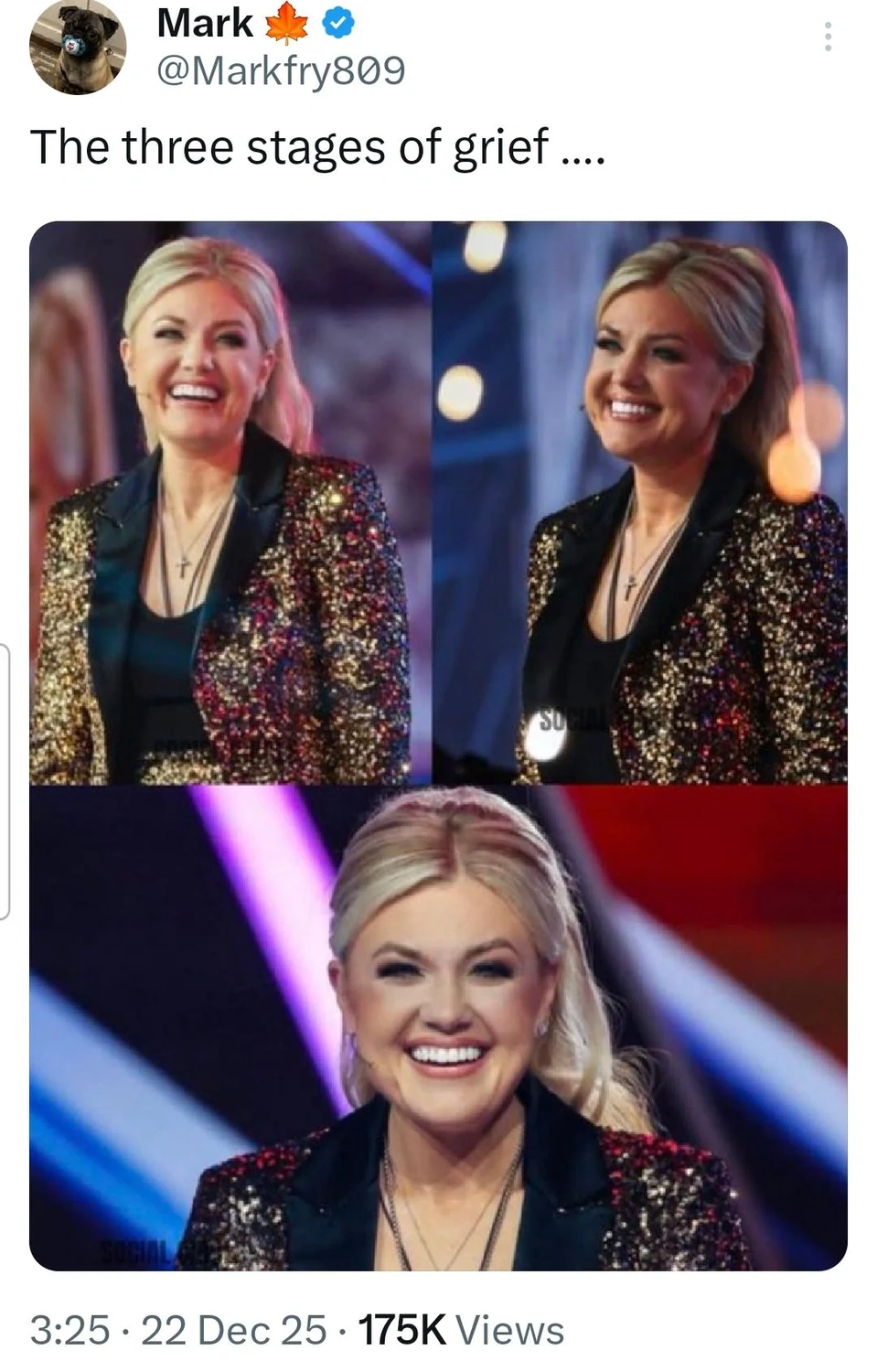
Erika Kirk and the Theatre of Grief
Erika Kirk and the Theatre of Grief
Charlie Kirk died and instantly became immortal.
Not immortal in the literal sense, of course. Immortal in the specifically American political sense, where death transforms a public figure into mythology before the blood has even dried. One second he was another conservative commentator saying increasingly outrageous things into a microphone, and the next he became martyr, patriot, fallen soldier, and symbol all at once. The internet moved with frightening speed. Memes collided with mourning. Conspiracy theories mixed with prayer circles. Politicians sanctified him while social media users turned his final moments into discourse content.
But while Charlie Kirk was transformed into a movement, Erika Kirk became something stranger.
She became uncanny.
The Internet’s Uncanny Widow
There is a particular cruelty in the way the internet watches women grieve publicly. Every gesture becomes evidence. Every facial expression becomes suspect. The widow is expected to perform sorrow correctly, but nobody can agree on what “correctly” even means.
That contradiction sits at the centre of the Erika Kirk spectacle.
People online became obsessed with her presence after Charlie’s death. Not simply because she was his wife, but because something about her seemed to deeply unsettle audiences. Entire comment sections spiralled into analysing her speeches, her voice, the way she cried, the way she smiled, the fact that she continued appearing publicly almost immediately after the funeral. Some called her emotionless. Others accused her of turning grief into branding. Still others insisted she looked haunted, artificial, almost unreal.
The response reminds me of Freud’s concept of the uncanny. The uncanny is not just fear or discomfort. It is the feeling of encountering something simultaneously familiar and alien. Something almost human, but slightly off.
Public grief often produces exactly that sensation.
We expect mourning to follow cinematic rules. We want the widow dressed in black, hidden from cameras, collapsing elegantly into sorrow. But real grief is ugly, contradictory, and frequently absurd. People laugh at funerals. People disassociate. People continue working because stillness feels unbearable. The body responds to loss in irrational ways.
The internet, however, does not tolerate irrationality well. It wants grief to be legible.
When Grief Becomes Content
The most unsettling aspect of this entire phenomenon is not Erika herself, but the machinery surrounding her.
Charlie Kirk’s death did not remain a private tragedy for more than a few hours. It immediately became productive. Memorials were organised. Speeches were livestreamed. Political messaging intensified. Fundraising efforts accelerated. His death became integrated into the broader mythology of Turning Point USA and the culture war ecosystem surrounding it.
The funeral became spectacle.
And in many ways, that spectacle reflects the logic of capitalism perfectly. Capitalism does not stop for grief. It aestheticises it. The body is barely cold before production resumes.
One of the strangest details surrounding Erika Kirk’s public image is how often she framed everything through the language of “the mission”. The mission must continue. The work must continue. The movement must continue. Even mourning itself became secondary to momentum.
That is what people were truly reacting to online. Not merely a widow behaving “strangely”, but the horrifying speed at which tragedy became organisational fuel.
There is something deeply dystopian about hearing exhausted employees praised for continuing to work through collective trauma because the cause is apparently bigger than the individual. It transforms grief into labour. Mourning becomes another form of productivity.
The widow becomes public relations.
The Campiness of Political Death
What fascinated me most while thinking about Erika Kirk was how bizarrely theatrical the entire situation felt.
Charlie Kirk’s death was treated with the iconography of sainthood and military sacrifice, despite the fact that he spent years as an inflammatory internet pundit saying things deliberately designed to provoke outrage. After his death, criticism itself became taboo in certain online spaces. To speak negatively about him was interpreted almost as blasphemy.
And yet simultaneously, the internet memefied the entire event within hours.
This contradiction feels uniquely modern. Politics today operates through spectacle more than ideology. Public figures are no longer simply politicians or commentators. They are characters within an endless performance cycle fuelled by algorithms and outrage.
The result is something grotesquely camp.
The widow cries on stage beneath patriotic imagery while conspiracy theorists accuse her of orchestrating her husband’s death. Speeches about God and national salvation circulate beside ironic edits and reaction memes. People speak about spiritual warfare through ring lights and podcast microphones.
Nothing feels fully real anymore.
That is perhaps why Erika Kirk appears so uncanny to audiences. She embodies the collapse between sincerity and performance. She is grieving, undoubtedly, but she is also performing inside a political machine that cannot afford to pause.
Christianity and the Aesthetics of Power
Another layer complicates all of this: religion.
The rhetoric surrounding Charlie Kirk after his death relied heavily upon evangelical language. Spiritual warfare. Evil forces. National destiny. Divine mission. The line between Christianity and nationalism became increasingly blurred until patriotism itself resembled religious ritual.
This is not unique to the Kirks, of course. White Christian nationalism in America has always depended upon spectacle. It thrives on narratives of persecution, martyrdom, and moral crisis. Public suffering becomes proof of righteousness.
That is why Charlie Kirk’s death was politically useful. Martyrs strengthen movements.
Erika Kirk now functions as both grieving widow and symbolic carrier of that mythology. Whether intentionally or not, her public image reinforces the idea that the movement transcends the individual. Charlie may be dead, but the mission survives.
The show must go on.
The Real Horror
It would be easy to reduce this entire phenomenon to internet absurdity, but I think the real horror is much larger than Erika Kirk herself.
The internet no longer allows grief to remain private, incoherent, or unfinished. Every tragedy is instantly converted into content. Mourning becomes performance because modern media demands visibility at all times.
And maybe that is what feels so uncanny about the entire spectacle.
Not that Erika Kirk appears unreal, but that capitalism has made grief almost impossible to distinguish from branding.
#DeathOfCharlieKirk #OnlineGrief #InternetCulture #Widowhood #PublicMourning
