The Digital Asylum: My Escape Route Rewritten

The Digital Asylum: My Escape Route Rewritten
The Digital Asylum: My Escape Route Rewritten
Once I hid in the glow of the internet, craving a safe, malleable escape. Today, the real world offers a different escape. This reflection links psychology, habit, and reality.
I often reflect on how our habits replace one realm with another. Once, I would flee into the world of Internet escapism; the glowing screen offered me sanctuary from the weight of the real world. According to psychological writing, using the internet as a way to escape one’s current reality is common: it is described as an “escape hatch” into virtual life when daily living feels too heavy.
In that time, the online world felt safer, more malleable, more controllable. In contrast, the real world posed uncertainties: deadlines, relationships, moods, and expectations. My thumb would scroll; my mind would float. I was not alone in this. Research finds that problematic internet use correlates with escapism, with users turning to online spaces to avoid real-life discomforts.
The Mirror-Image Shift
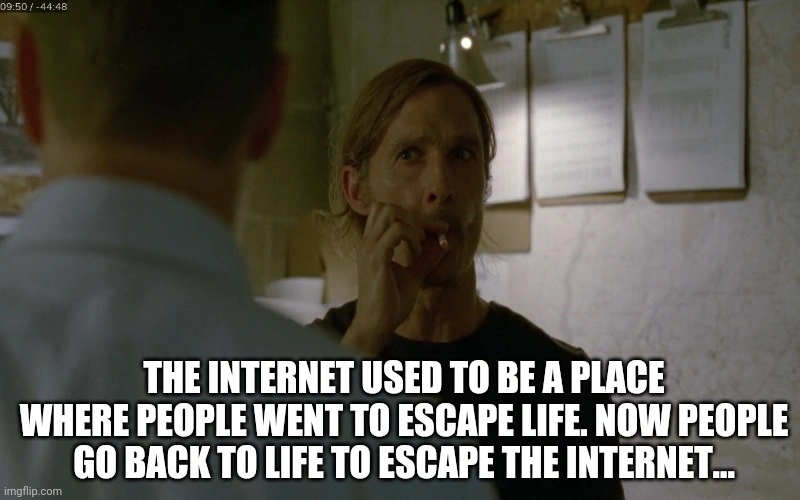
Yet now I find the opposite happening: I step outside, into the real world, to escape the internet. In effect, I have turned the compass 180°. What has changed? Perhaps the internet no longer feels like refuge but instead like another form of confinement, a filter bubble, a constant stream of notifications, an expectation of response. It is no longer only about being “on” but being “always on”. I feel the need to breathe outside of it.
https://x.com/britmebaby/status/1842210722316509203 🔗
This change bears some psychological weight. Studies suggest that when the internet is used primarily to escape offline interactions rather than to enhance them, loneliness and disengagement increase. In other words, when the screen becomes the default retreat rather than a tool for connection, something soulful is lost. I began to sense that the real world, with its unpredictability, its tactile contingency, its imperfect rhythms, offered a more genuine sanctuary.
The Real World as Sanctuary
Walking in the street, feeling the air, reading someone’s expression across a café table, listening to ambient sound not mediated by an app: these have become my new comforts. It is ironically novel: for so long I prized the digital for its lack of friction; now I prize the world for precisely its friction. In literature, we often speak of liminal spaces, of thresholds. I see the boundary between online and offline as itself liminal, and I now choose the “outside” side.

And in this choice, I recognise the value of presence, of unpredictability, of embodied experience. The internet gave me escape. But the real world gives me re-entry. I step back into the flow of lived experience, relinquishing some of the curated control that made the screen so seductive. I walk away from the “infinite scroll” and into the finite horizon.
On Ambivalence and Balance
Of course, I do not advocate rejecting the internet entirely. It remains a vital resource: for research, for connection, for creativity. But the way I use it has shifted. I no longer use it merely to avoid; I use it more consciously. I ask: What am I fleeing from? What do I hope to find? In the past, I did not ask such questions; I simply logged in. Now I log out.
In academic terms, one might frame this as a negotiation between the “stimulation hypothesis” and the “displacement hypothesis” of internet use: whether digital media stimulate and enhance real-life relationships, or displace and erode them. I have experienced both sides: the early escape into virtual comfort, and the later real-world return seeking something richer.
Writing Myself into Reality
Writing this from my desk, I recognise that this shift is personal but reflective of broader cultural rhythms. As a literature student, I am attuned to narrative arcs: rise, conflict, transformation. This is one such arc in my own life.
To anyone reading this who also used the internet as a sanctuary, I pose the question: What happens when the simplicity of the screen begins to feel like another kind of cage? And to anyone who now seeks the world, perhaps uneasy, perhaps raw: take the step. Walk outside. Sit somewhere you cannot touch your phone. Let the world pull you back.
In the end, the real world is not just something we escape from by hiding online; it can be something we intentionally return to, to reclaim a sense of texture, presence, unpredictability. My escape route has been rewritten. The refuge is no longer behind a screen. It is beneath the sky and between the sounds and in the pause when I choose to look up.
#Escapism #MentalHealth #DigitalWellbeing #RealityCheck #Habits

Login to comment.
No thots yet. Be the first to share your thoughts!