The Trad-Wife to Rage-Mother Pipeline

The Trad-Wife to Rage-Mother Pipeline
The Trad-Wife to Rage-Mother Pipeline
The era of the 'cozy' influencer is dying. In the desperate hunt for views, aesthetic perfection is being replaced by calculated parenting fails and rage-bait. Here is why the algorithm wants you to hate-watch.
It started with a sourdough starter. It always does.
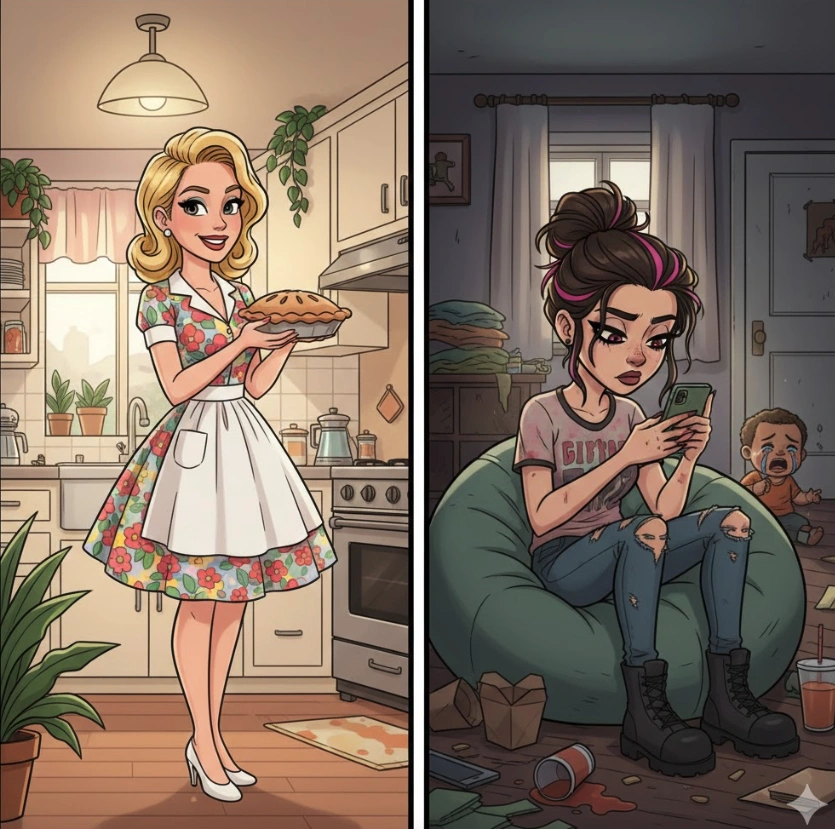
For a brief, flickering moment in the pantheon of internet history, the algorithm was obsessed with peace. We had the 'Trad-Wife' aesthetic: a linen-clad, slow-living fantasy where women churned their own butter, arranged wildflowers in reclaimed glass jars, and spoke in tones so soft they barely registered above a whisper. It was performative, sure. It was a simulacrum of domestic bliss that ignored the realities of labor and economics, but it was, at the very least, quiet.
But the internet hates quiet. More importantly, the attention economy is a beast that cannot be fed on beige aesthetic alone. Eventually, the views plateau. The audience gets bored of the perfect loaf of bread. Of the florals.
And this is where the pivot happens. This is where the Trad-Wife takes off the apron and picks up the controversial opinion.
Welcome to the 'Rage-Mother' pipeline, the latest, darkest evolution of lifestyle content where creators are trading in 'comfy' vibes for calculated controversy.
The calculated controversy is nothing new. Aamir Khan has been creating controversies to sell his movies since I was five. Marilyn Monroe made a whole career on it. So did Princess Diana and many others, one way or another. So what's new?
The Economics of Hate-Watching
To understand why your favorite wholesome mom vlogger is suddenly posting about letting her toddler drink espresso or explaining why she doesn’t believe in sunscreen, you have to look at the machinery beneath the screen.
In the early days of social media, the currency was aspiration. We watched people because we wanted to be them. The Trad-Wife offered a fantasy of order in a chaotic world. But aspiration has a ceiling. Envy turns to resentment, and boredom sets in quickly.
Outrage, however? Outrage is a bottomless pit.
Sociologically speaking, we have shifted from an era of emulation to an era of interrogation. The algorithm realizes that a user will spend 15 seconds watching a beautiful morning routine, but they will spend 20 minutes reading the comments on a video where a mother claims she lets her kids play with rusty nails to 'build immunity.'
Engagement is engagement. To the platforms, a comment section filled with people screaming "This is child neglect!" is worth infinitely more than a comment section filled with "So cute! 💖." The former drives shares, stitches, duets, and reaction videos. It creates a discourse cycle. It keeps the app open.
The Death of the 'Comfy' Creator
I view this through the lens of literary tragedy. The content creator is the protagonist who realizes that virtue doesn’t pay the rent. It’s a distinctively modern Faustian bargain: trade your reputation as a 'good mother' for the algorithmic boost of being a 'controversial one.'
We see this pivot happen in real-time. A creator notices that a video where her kitchen was messy got more views than the one where it was clean. Next, she notices that a video where she voiced a slightly unpopular opinion on sleep training went viral. The dopamine loop tightens.
Suddenly, the content isn't about the lifestyle; it's about the friction.
- The Trad-Wife Era: "Here is my homemade organic puree." (10k views)
- The Transition: "Why I don't force my kids to eat vegetables." (100k views)
- The Rage-Mother Era: "I feed my kids raw chicken to toughen them up." (1M views)
Okay, the raw chicken is hyperbole (mostly), but the trajectory is real. The pressure to remain relevant forces creators to become caricatures of negligence or contrarianism. They become the villains in their own story because the internet loves a villain.
Where Did the Nuance Go?
This pipeline suggests a grim future for digital discourse. It erases the middle ground. You are either a perfect, unattainable deity of domesticity, or you are a reckless agent of chaos. There is no room for the 'Good Enough Mother', the one D.W. Winnicott wrote about, because she is boring. She doesn’t stop the scroll.
We are losing the spaces for quiet reflection. The platforms we inhabit are designed to turn thoughts into weapons. If you want actual nuance, you have to leave the scroll-hole. Honestly that's why I'm trying to write essays at a place where the architecture favors long-form thought over 15-second shock value. We need more social media platforms like Thoxt, where I've seen parents write essays about the complexities of modern parenting without needing to bait the audience into a child-assaulting frenzy just to be seen. But on the main stage, TikTok, Reels, Shorts, nuance is dead weight.
The Audience is Complicit
We can blame the creators, and we can blame the algorithm, but as a Lit lover, I have to look at the reader. That’s us.
We claim we want wholesome content, but we click on the disaster. We are the rubberneckers on the digital highway. The 'Rage-Mother' exists because we need someone to feel superior to. When we watch the Trad-Wife, we feel inadequate. When we watch the Rage-Mother, we feel like saints in comparison.
"I may not bake my own bread," we tell ourselves, "but at least I won't let my infant play in traffic."
It is a symbiotic, parasitic relationship. The creator gets the views; we get the moral high ground. And somewhere in the middle, the concept of a normal, messy, private human life is ground into dust for entertainment.
#TradWife #RageMother #InternetCulture #CreatorEconomy #Algorithm #socialmedia #culture
